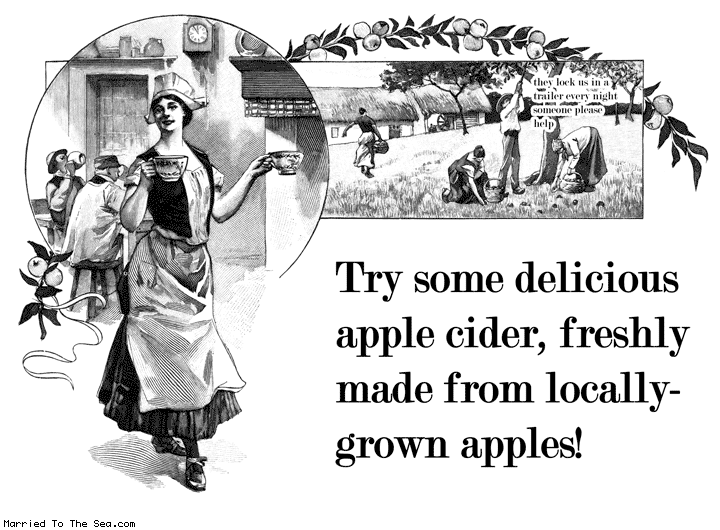
I think anyone aspiring to creative writing would do well to get themselves on the mailing list of the Vermont Country Store. Their catalog starts showing up in our mailbox around the same time as the stinkbugs, and continues appearing as frequently and predictably. The VCS catalog is a staple—nay, a ritual—of bathroom reading from early fall to mid-winter, about the point when it slips its staples and finally falls apart.
It is a paragon of tautly-crafted manipulative prose, each product description a compact haiku-length dissertation cleverly crafted to push buttons you didn't know you had.
Each item in the catalog is worthy of a massive piling-on of scientifically selected adjectives and adverbs, each one specifically designed to trigger the release of repressed memories of a common idyllic childhood we never shared. The house was bigger, the windows frostier, the rooms cheerier, the beds both higher and cozier, the breakfasts heartier, the hot chocolate richer, the sledding swifter, our parents wiser, kinder, happier and more beautiful, the Christmas Tree taller, the tinsel brighter, the goose crispier and the presents more wonderful than we could ever have hoped.
I will confess we receive this epistle regularly because we purchased items from this land of make-believe in the past. And the thing is, once the goods arrive on this side of the catalog—reality chasm, they're just...stuff. Stuff like you could buy pretty much anywhere.
Sure, a lot of it is hard to find—but most of the time that's because people stopped buying it years ago and people stopped making it years ago because, hey, in truth back then it was crap, and by golly, it's still crap now.
Nostalgia does not by and of itself validate things; in most cases it's just stuff, like it was back then when we didn't buy it the first go-round. The items are, for the most part, things you have probably walked past in your regular rounds of shopping time and again, with good reason. (Creamed Chipped Beef, anyone?) Yet from their testimonial copy, each item means something special to someone out there, enough for them to resurrect it or recommission it in some cases and to make an effort to stock it at least for a little while. As they say, there's no accounting for taste.
I don't think I have ever gotten something from the VCS that didn't come packaged with its own certain tiny measure of disappointment. It may be that the VCS catalog's greatest value lies in its ability to gently teach children how to gracefully accept disappointment, how to read between the lines of artfully crafted marketing prose, and to understand in a simple way that things aren't always what they seem.
But I gotta say, the catalog itself never disappoints. I love the writing—the unrelenting Rockwellian optimism, the naive cheer, the three or four coats of bright shiny adjectives, the perky and artfully dated design sense, the creation of a whole world within the slick covers. The arrival of the first catalog marks the beginning of the imaginary season they taught us about back in second grade.
Get on their mailing list, if you aren't already. Read the catalog. Throw 'em a bone from time to time, just to prop that imaginary world up a little while longer. There's no harm in playing along.
Addendum: If you're ever in Vermont, you owe it to yourself to check out the brick-and-mortar VCS, which is actually made of wood & stuff. It's the real-life version of the catalog, and as I recall, there are at least two or three of them salted throughout the state. Visited the one in Weston on the grand Vermont tour of 2001, and it was worth the side trip.
Thursday, November 05, 2009


TOTD
Isn't a little bit disturbing that the three leading intellectuals of the modern Republic Party—Glenn Beck, Sean Hannity and Rush Limbaugh—are all college dropouts?
Scary.
Scary.
NASA explores the Antarctic
NASA is currently flying a DC-8 over Antartica, using the aircraft to take the place of a failing satellite to probe the melting Antarctic ice cap with lasers. One can only hope the scientists involved have learned the lessons of the ill-fated Miskatonic University expedition of 1930-1931.
One shudders to think.
One shudders to think.
Wednesday, November 04, 2009
Last of the Season?
I stopped off in the Big Effer last night on the way home to take care of a couple of errands. In the grocery store I noticed a weathered man, within a few years of my age, pushing a large backpack around in his grocery cart, gathering a few compact necessities. In the cart with the pack was a long and worn hiking staff.
When I was done shopping, he was out front of the store reworking the contents of his pack to accommodate his new provisions, carefully removing extraneous packaging and delicately repacking everything in just the right place. I nodded to the man and we exchanged pleasantries, and I walked across the parking lot to the drugstore. I took a wild guess he was heading back to the AT trail crossing on the ZTH.
As I pulled out of the parking lot, I saw him hiking up the shoulder of the road a short distance away. He would extend his thumb in a desultory manner as each car passed him by, so he appeared genuinely surprised when I pulled over in a driveway behind him.
He quickly confirmed that he was, indeed, heading to the trailhead with a fresh load of groceries, and shucked the bulky pack with a practiced grace. We loaded it into the back seat—trunk full of crap—and he politely asked if I would prefer he rode in back with it.
For some reason, that struck me as very funny, and I walked over and unlocked the passenger side for him. Aside from his obviously being a heavy smoker (yeah, what a surprise...not that uncommon for hikers, from what I've found) he was acceptable company. We drove the short distance to the trailhead tentatively, with a couple of false stops before finding the right place—I can never remember exactly where it is, and neither, apparently, can the hikers.
His story, in brief, was that he had departed Delaware Water Gap on the Pennsylvania-New Jersey border in September, heading southbound. He planned to hike as far south as he could before winter set in, find a place to stay for the winter, and return to Delaware Water Gap to begin hiking northbound in the spring.
We pulled over at the now-familiar looking trailhead. The early November sun had dipped below the Blue Ridge while we were both still back at the store. Twilight was already beginning to fade in the few minutes it took us to reach the road crossing, and the air was cooling rapidly from a mild autumnal chill down towards the mid-twenties it would reach by morning.
Without delay, we got out and unloaded his pack from the back seat. He thanked me profusely for my kindness, shook my hand enthusiastically, and hefted his pack onto his back. He was encouraged by the unexpected head-start I had given him, and though the light was failing, I reminded him the full moon would rise in short order.
He paused to tell me about the beauty and wonder of hiking the last few miles into last night’s shelter by the light of the moon, then smiled, thanked me again, and set off briskly down the trail into the cold dark woods. Part of me envied him his journey. There aren’t that many long-distance hikers left on the AT come November; besides the peace and solitude, the bare trees and crisp cold air would offer scenery unimaginable during the warmer months.
But the bigger part of me couldn’t help but think how cold it was going to get up on the mountain by morning, and how far it is to Springer Mountain.
When I was done shopping, he was out front of the store reworking the contents of his pack to accommodate his new provisions, carefully removing extraneous packaging and delicately repacking everything in just the right place. I nodded to the man and we exchanged pleasantries, and I walked across the parking lot to the drugstore. I took a wild guess he was heading back to the AT trail crossing on the ZTH.
As I pulled out of the parking lot, I saw him hiking up the shoulder of the road a short distance away. He would extend his thumb in a desultory manner as each car passed him by, so he appeared genuinely surprised when I pulled over in a driveway behind him.
He quickly confirmed that he was, indeed, heading to the trailhead with a fresh load of groceries, and shucked the bulky pack with a practiced grace. We loaded it into the back seat—trunk full of crap—and he politely asked if I would prefer he rode in back with it.
For some reason, that struck me as very funny, and I walked over and unlocked the passenger side for him. Aside from his obviously being a heavy smoker (yeah, what a surprise...not that uncommon for hikers, from what I've found) he was acceptable company. We drove the short distance to the trailhead tentatively, with a couple of false stops before finding the right place—I can never remember exactly where it is, and neither, apparently, can the hikers.
His story, in brief, was that he had departed Delaware Water Gap on the Pennsylvania-New Jersey border in September, heading southbound. He planned to hike as far south as he could before winter set in, find a place to stay for the winter, and return to Delaware Water Gap to begin hiking northbound in the spring.
We pulled over at the now-familiar looking trailhead. The early November sun had dipped below the Blue Ridge while we were both still back at the store. Twilight was already beginning to fade in the few minutes it took us to reach the road crossing, and the air was cooling rapidly from a mild autumnal chill down towards the mid-twenties it would reach by morning.
Without delay, we got out and unloaded his pack from the back seat. He thanked me profusely for my kindness, shook my hand enthusiastically, and hefted his pack onto his back. He was encouraged by the unexpected head-start I had given him, and though the light was failing, I reminded him the full moon would rise in short order.
He paused to tell me about the beauty and wonder of hiking the last few miles into last night’s shelter by the light of the moon, then smiled, thanked me again, and set off briskly down the trail into the cold dark woods. Part of me envied him his journey. There aren’t that many long-distance hikers left on the AT come November; besides the peace and solitude, the bare trees and crisp cold air would offer scenery unimaginable during the warmer months.
But the bigger part of me couldn’t help but think how cold it was going to get up on the mountain by morning, and how far it is to Springer Mountain.
Tuesday, November 03, 2009
Something I wrote thirty-five years ago
This is something I wrote about thirty-five years ago, and it still interests me for a couple of reasons. First is that I think I wrote it when I had just finished reading ZATAOMM, and was blown away by it as the first philosophical book of any kind I had ever read (it shows pretty directly). Second, it shows an early incarnation of my feelings about hiking versus driving, which have translated into motorcycling versus driving. Third, I now find myself living within sight of the mountain in question, and seeing it pretty much every day—it's what I look at as I drive down the lane to home.
I cringe a little bit when I read this, because it is probably my first real attempt at putting my thoughts down on paper. But the persistent threads fascinate me, and the underlying themes are things that still fascinate me.
I cringe a little bit when I read this, because it is probably my first real attempt at putting my thoughts down on paper. But the persistent threads fascinate me, and the underlying themes are things that still fascinate me.
"Travelling in a car is the least forgiving way to go. Forgiving of the crime of caring, of wanting to know more and see deeper. You see something different, and it excites or interests you. But you can't just stop; the car won't let you. So after this happens many times, you get calloused; it hurts to lose a good thought. So many people just give up seeing things. When you're walking, it's better, but you still have a destination to reach, and that's what you're there for. Not to see clearer, because you can't plan that."
"This idea came to me while I was looking at a mountain. It wasn't the first time, though; many years ago I knew this. This mountain was a backdrop, a shelter for [the town of] Flint Hill, and it seemed such an essental part of the town that Flint Hill couldn't exist in any other context."
"Flint Hill, without knowing it, belonged to that mountain more than anything else..."
Orders of Magnitude
A while back, I confessed to dispatching two black snakes who had been harassing our chickens. I threw the limp lifeless body of one snake into the tall grass at the edge of the woods, in order for it to be assimilated by the various and sundry woodland decomposers whose job it is to make such things right.
A few days later, I was walking up the driveway towards the pines when I was startled by a commotion to my left. Out of the deep grasses and scrub a turkey buzzard rose majestically and swooped across the driveway and garden. It grabbed great fistsful of air with its pinions, pulling itself into the sky with unimaginable power and grace, slowly gaining speed and altitude until it disappeared above the pines to the north.
I peered into the grasses from where this pterosaur had launched, and found what looked like a tiny scrap of frayed rope—the few remains of the snake, picked clean of flesh and skin. What the bird with a wingspan greater than my armspan found for sustenance in that tiny morel, and how it discovered it in the first place, astonished me.
The next afternoon, we sat quietly in the front yard, enjoying a leisurely afternoon in the warm sun. All at once, there was a commotion, and a turkey buzzard once again rose from the tall grasses, taking the same trajectory. But something amazing happened: The buzzard flushed a pileated woodpecker from a nearby oak tree, and in its haste, it followed a parallel trajectory with the buzzard. (Normally, a pileated woodpecker is one of the largest birds you will see in the woods, with a two-foot wingspan and a distinctive flight pattern—it is majestic and beautiful with its distinctive brilliant red-white-black plumage). And at the same instance, just before our faces, a few yards away, a ruby-throated hummingbird hovered in mid-flight:
So for one split second, all in the same line of sight, at the same instant—a turkey buzzard, a pileated woodpecker, and a ruby-throated hummingbird.
And they were gone.
I peered into the grasses from where this pterosaur had launched, and found what looked like a tiny scrap of frayed rope—the few remains of the snake, picked clean of flesh and skin. What the bird with a wingspan greater than my armspan found for sustenance in that tiny morel, and how it discovered it in the first place, astonished me.
The next afternoon, we sat quietly in the front yard, enjoying a leisurely afternoon in the warm sun. All at once, there was a commotion, and a turkey buzzard once again rose from the tall grasses, taking the same trajectory. But something amazing happened: The buzzard flushed a pileated woodpecker from a nearby oak tree, and in its haste, it followed a parallel trajectory with the buzzard. (Normally, a pileated woodpecker is one of the largest birds you will see in the woods, with a two-foot wingspan and a distinctive flight pattern—it is majestic and beautiful with its distinctive brilliant red-white-black plumage). And at the same instance, just before our faces, a few yards away, a ruby-throated hummingbird hovered in mid-flight:
So for one split second, all in the same line of sight, at the same instant—a turkey buzzard, a pileated woodpecker, and a ruby-throated hummingbird.
And they were gone.
Monday, November 02, 2009
The fall garden (200-?)
Fall is the most compelling time in the garden. In place of the long, gentle unwinding and developing that characterizes the warm season, the open ended nature of growth, there is an end. Fall brings completion, finality, conclusion. Whether it comes in the guise of fruition and harvest, fading falling blossoms, or the abrupt discipline of the first killing frost, fall ends the expansion that drives the garden.
Look to the garden then, to see how fall expresses itself. Look at the haggard tomatoes, so recently bold and dominant lording a green canopy over all else. Now they stand exhausted, yellowing foliage dripping, desperately struggling to bring a last faint blush to their resolutely green fruit.
See the lone pumpkin, no gold yet lighting its cheek, looming dark green and glossy. It sits alone, isolated, abandoned by its vine during a hasty retreat. Yet to be decided is whether it has a use or not; it may be left to rot as it sits.
The ranks of peppers stand, drooping, weighted down by scores of fruit camoflaged in the deep green leaves. They mimic the twisted posture of old men loaded with cares and devoid of hope. Like the nearby tomatoes, they hasten to bring a last few fruit to ripeness before they are struck down. Loaded as they are, their future seems unlikely—the hand of the gardener will take all they bear, unformed and immature as they may be, to ripen or rot inside.
The barren and dessicated cornstalks stand, bolder in their death than their living compatriots. They stand tall and proud over the garden, bleached by the sun.
Look past the towering failures; look low, down and see the plants that prosper even as the frost surely approaches. These are the modest plants that have yet to take their place in the season's bounty, yet they will, long after the others have rotted and been turned under.
Row after row, where the towering titans of summer have departed, stand the small, inconspicuous grey plants.
Look to the garden then, to see how fall expresses itself. Look at the haggard tomatoes, so recently bold and dominant lording a green canopy over all else. Now they stand exhausted, yellowing foliage dripping, desperately struggling to bring a last faint blush to their resolutely green fruit.
See the lone pumpkin, no gold yet lighting its cheek, looming dark green and glossy. It sits alone, isolated, abandoned by its vine during a hasty retreat. Yet to be decided is whether it has a use or not; it may be left to rot as it sits.
The ranks of peppers stand, drooping, weighted down by scores of fruit camoflaged in the deep green leaves. They mimic the twisted posture of old men loaded with cares and devoid of hope. Like the nearby tomatoes, they hasten to bring a last few fruit to ripeness before they are struck down. Loaded as they are, their future seems unlikely—the hand of the gardener will take all they bear, unformed and immature as they may be, to ripen or rot inside.
The barren and dessicated cornstalks stand, bolder in their death than their living compatriots. They stand tall and proud over the garden, bleached by the sun.
Look past the towering failures; look low, down and see the plants that prosper even as the frost surely approaches. These are the modest plants that have yet to take their place in the season's bounty, yet they will, long after the others have rotted and been turned under.
Row after row, where the towering titans of summer have departed, stand the small, inconspicuous grey plants.
Bad meat, bad karma
Today another recall of shitburger—ground beef deliberately and with malice aforethought blended with manure to make a few extra pennies per pound.
And how much was it this time?
500, 000 pounds. 250 TONS. For what it's worth, that translates into about six hundred head of cattle raised, fattened, tortured, slaughtered, butchered, and now to sent directly to the landfill. What an utter disgrace.
Or, to look at it another way, I'd guess it's about three thousand times the weight of the two poor people who have died so far from eating the purposely poisoned meat—if that's any kind of equivalency.
What the eff is wrong with us that this goes on?
And how much was it this time?
500, 000 pounds. 250 TONS. For what it's worth, that translates into about six hundred head of cattle raised, fattened, tortured, slaughtered, butchered, and now to sent directly to the landfill. What an utter disgrace.
Or, to look at it another way, I'd guess it's about three thousand times the weight of the two poor people who have died so far from eating the purposely poisoned meat—if that's any kind of equivalency.
What the eff is wrong with us that this goes on?
The Rules of Hiking:
- Hiking is walking, not running. Don't race.
- Keep your hands free. Don't carry anything big in your hands or walk with your hands in your pockets. This means no walking sticks.
- Talk quietly so only the people in your group can hear you. Don't disturb other people.
- Keep a steady pace. Hum a song quietly to help you.
- Drink plenty of water and snack when you feel hungry—but—don't take your first break until you've walked for at least a half and hour. That lets you set a good pace.
- Stop and take care of 'hot spots' on your feet before they become blisters, which hurt a lot more.
- Don't pick flowers or other pretty things. Leave them for the next person to enjoy. The only exception is wild fruit like blackberries or blueberries. They make a great treat, and give you energy, but only eat what you want while you're hiking. Don't pick them to take home or eat later on.
- Take home everything you brought with you—don't leave anything behind. Even little bits of food, like an apple core or an orange peel, can make things less fun for the next people to come through.
- Leave things better than you found them. Carry a small trash bag and pick up any trash you might find. The animals will appreciate it, and you set a good example for other people, too.
Four-Mile Run, Falls Church, October 199-?
The warm haze of an early October afternoon—end of a day of work, full of tension, unremarked, unaddressed.
On the wind, the quiet smell of a place nearby, yet a generation removed—
At hand the stream where I played so often so many years ago—the place that shaped that time, that gave color and flavor to a young boy's life.
In this one place then, the stream remains as it was twenty-five years ago. The same leaves overhang the still waters, the same small insects play across it's quiet surface; the same small little fishes probably hide in its shaded nooks.
On the wind, the quiet smell of a place nearby, yet a generation removed—
At hand the stream where I played so often so many years ago—the place that shaped that time, that gave color and flavor to a young boy's life.
In this one place then, the stream remains as it was twenty-five years ago. The same leaves overhang the still waters, the same small insects play across it's quiet surface; the same small little fishes probably hide in its shaded nooks.
Sunday, November 01, 2009
Today
I butchered five of our chickens.
Addendum: Apparently I can't count. I butchered four of our chickens. Spicy remains.
Addendum: Apparently I can't count. I butchered four of our chickens. Spicy remains.
Beast health report
Yesterday was Beast's annual trip to the motoveterinarian. Nothing major, just a 6K checkup, plus a sniffle here, a drip there, some weird blinky things, et cetera. I spent much of the morning and early afternoon pacing in the waiting room, allaying my nervousness by periodically buying more stuff I don't really need but want none the less.
Shortly after lunch, Beast was back with a clean bill of health and for a whole lot less pain than I was fearing. But the best part of a trip to the motoveterinarian is getting back on the road and taking that first ride when everything is back to 100%, or to zero, depending on how you want to look at it. It's always amazing to crack open the throttle and get a great big handful of WHOOSH in return...
Performance, handling, gestalt, karma—all where they are meant to be. AND (tee hee)...heated glove liners! BRING IT ON, WINTER!!
Shortly after lunch, Beast was back with a clean bill of health and for a whole lot less pain than I was fearing. But the best part of a trip to the motoveterinarian is getting back on the road and taking that first ride when everything is back to 100%, or to zero, depending on how you want to look at it. It's always amazing to crack open the throttle and get a great big handful of WHOOSH in return...
Performance, handling, gestalt, karma—all where they are meant to be. AND (tee hee)...heated glove liners! BRING IT ON, WINTER!!
Piling on the HOG
Friday I rode to work. Saturday I rode down to the big F and back. En route, I kept noticing cars with "Harley Owners Group" specialty plates (including a Prius), pickup trucks with various H-D emblems on them, a couple of proud H-D box trailers with Canadian plates headed to Florida for Bikesgiving, and one full-blown Special Edition H-D pickup truck. I don't recall which Detroit behemoth manufactured this particular orange-and-black gem, but it's one or the other of those Detroit Behemoths whose emblem Calvin is seen peeing on from the back window of rival vehicles. Sticker is generally located above and in front of the trucknutz. But I digress.
Passing these folks, I get the impression from glancing in the driver's side window that the sub-rosa acronym is actually "Harried Old Guys" or maybe "Heavy Old Guys." In any case. Actual number of bona-fide H-D motorcycles seen in action during that same period—about four hours, morning, midday and afternoon, two-hundred miles of mixed interstate, divided highway, two-lane highway and backroads?
Er, um...one? Maybe?
And then there's this. Seriously—I didn't go looking for this, just happened to stumble upon it, and appreciated the germaneity:

Whoever wrote this obviously has no real-world experience and no idea what he is talking about. They stopped making Zima over a year ago.
I report. You decide.
Passing these folks, I get the impression from glancing in the driver's side window that the sub-rosa acronym is actually "Harried Old Guys" or maybe "Heavy Old Guys." In any case. Actual number of bona-fide H-D motorcycles seen in action during that same period—about four hours, morning, midday and afternoon, two-hundred miles of mixed interstate, divided highway, two-lane highway and backroads?
Er, um...one? Maybe?
And then there's this. Seriously—I didn't go looking for this, just happened to stumble upon it, and appreciated the germaneity:

I report. You decide.
Thursday, October 29, 2009
A Long Time Ago, in a State Far, Far Away...
 In the Fall of 2004 Sparky and I had the opportunity to rent bikes from Dubbelju Motorcycle Rentals in San Francisco for an all-too-brief ride up to Napa-Sonoma, including traversing the spectacular Trinity Road between the two valleys.
We picked up the bikes—an F650 for me and a Sportster for Sparky—as early as we could, and headed out through the obligatory fog across the Bay Bridge.
The fall weather was spectacular, but we barely had time for a quick lunch in St. Helena before we had to return across Trinity Road and south to San Francisco.
 We did take the time to stop at the Marin County highlands for the obligatory Golden Gate photo op, then wound our way through evening rush-hour traffic in an unfamiliar city (dead reckoning all the way) in order to drop the bikes back at Dubbelju by closing time, grab the gear we had stashed there, and grab the BART to the airport for the red-eye back to D.C.
 We had hoped to snag a pair of big-bore Beemers for the day, but it was first-come, first served, or a Hobson's choice, or something like that. In any case, Sparky was tickled with the Harley, and I was pretty happy with the 650.

I had ridden the 650 (as service loaners) before, but this was a longer ride on a wide mix of roads—unfamiliar urban congestion, interstates, divided highways and narrow, uber-twisty two lanes. I spent many miles standing on the footpegs, simply because the bike inspires that kind of "irrational exuberance" and in hindsight, I think it probably was the perfect choice for the kind of one-up, lightly-loaded riding we were there for.
We were both pretty exhausted by the time we settled in for the flight home, and disappointed our ride had been so truncated. I'm failry certain that if either of us ever get back out to the left coast, we'll try and make a better go of it.


Monday, October 26, 2009
Winging it
I gotta say that freestyling bread has got to be maybe the most impressive thing I have ever seen done in a kitchen—a kind of yeast-and-gluten based jazz, an improvisational art form that I plainly do not have the stones to try. It is an interpretive dance, dusted with flour.
Mary has been doing this of late, and Madeline does it also. Now, I baked my first loaf of bread in, what—third grade or something like that? And since then, I have baked all sorts of breads over the decades, and lots of other goodies as well. I consider myself a reasonably accomplished amateur baker. But, as I learned from my mother, I bake always using a recipe, followed with great deliberateness and devotion. How do these two do it?
It's almost scary for me to watch the bold and fearless way these women bake: intuitive, insightful, free-form, based on solid experience and whatever ingredients are at hand. Everything goes into the big stainless steel bowl in its turn (nothing seems to get measured) where it's mixed, then kneaded, then risen: a single vessel for the whole process. Four round loaves emerge from this crucible to nestle together on a big baking sheet, making a giant clover-leaved loaf, each leaf with two flat sides and a broad dome.
The motivation to bake is often some ingredient that needs to get used up; dairy-based, typically, so the breads are usually rich with cottage cheese or the equivalent. Some mix of herbs usually enlivens the flavor, often finely minced onion as well, a perfect compliment for a 1/4 rye-1/4 whole wheat loaf, like the ones we just enjoyed.
I watch it happen, and stand back and keep out of the way. It's a music I can't play...though I certainly enjoy listening, and am a willing audience.
********************
On the other hand, I am pretty good at free-style cooking.
Sunday morning I announced we were having quiche for dinner, and Mary concurred. When the time came, at the end of a long day of many hard tasks large and small, we went at it.
Mary made the crust, in this instance using the old-reliable recipe—pie crusts are treacherous and notoriously vindictive creations who won't hesitate to turn on you if you show the slightest weakness or fear or relinquish an iota of control for a moment. She prevailed, predictably.
I began making the filling by cutting up a hunk of smoked pork (like bacon but without the cure) and sauteing it; then adding finely minced onion, some finely chopped kale stems and, shortly after those, the kale leaves; then some sliced white mushrooms and salt and pepper. While that was all slowly cooking together, I beat a handful of eggs, some freshly-skimmed cream, and some cottage cheese until it was frothy. As soon as Mary had the two crusts ready, I divided up the kale mixture between the crusts and poured the egg filling over them.
The quiches were done in about a half an hour, along with a pumpkin-like winter squash I threw together. The squash was just cleaned out and baked with some cider, butter, brown sugar and spices. The two quiches and the squash together would make about three full meals for the two of us, with mostly local ingredients and without recipe (...excepting the crust...) with about thirty minutes prep time all told.
The trick is having a wonderful assortment of outstanding ingredients on hand, and a willingness to use them how you see fit. No recipe for the filling, just the miracle of all those foolproof pieces to put together like a puzzle. I suppose I could try and apply that approach to baking, but...
Nah. I'm not even going to pretend like that's going to happen. I will leave it to the two virtuosos. I know when to leave well enough alone.
Mary has been doing this of late, and Madeline does it also. Now, I baked my first loaf of bread in, what—third grade or something like that? And since then, I have baked all sorts of breads over the decades, and lots of other goodies as well. I consider myself a reasonably accomplished amateur baker. But, as I learned from my mother, I bake always using a recipe, followed with great deliberateness and devotion. How do these two do it?
It's almost scary for me to watch the bold and fearless way these women bake: intuitive, insightful, free-form, based on solid experience and whatever ingredients are at hand. Everything goes into the big stainless steel bowl in its turn (nothing seems to get measured) where it's mixed, then kneaded, then risen: a single vessel for the whole process. Four round loaves emerge from this crucible to nestle together on a big baking sheet, making a giant clover-leaved loaf, each leaf with two flat sides and a broad dome.
The motivation to bake is often some ingredient that needs to get used up; dairy-based, typically, so the breads are usually rich with cottage cheese or the equivalent. Some mix of herbs usually enlivens the flavor, often finely minced onion as well, a perfect compliment for a 1/4 rye-1/4 whole wheat loaf, like the ones we just enjoyed.
I watch it happen, and stand back and keep out of the way. It's a music I can't play...though I certainly enjoy listening, and am a willing audience.
********************
On the other hand, I am pretty good at free-style cooking.
Sunday morning I announced we were having quiche for dinner, and Mary concurred. When the time came, at the end of a long day of many hard tasks large and small, we went at it.
Mary made the crust, in this instance using the old-reliable recipe—pie crusts are treacherous and notoriously vindictive creations who won't hesitate to turn on you if you show the slightest weakness or fear or relinquish an iota of control for a moment. She prevailed, predictably.
I began making the filling by cutting up a hunk of smoked pork (like bacon but without the cure) and sauteing it; then adding finely minced onion, some finely chopped kale stems and, shortly after those, the kale leaves; then some sliced white mushrooms and salt and pepper. While that was all slowly cooking together, I beat a handful of eggs, some freshly-skimmed cream, and some cottage cheese until it was frothy. As soon as Mary had the two crusts ready, I divided up the kale mixture between the crusts and poured the egg filling over them.
The quiches were done in about a half an hour, along with a pumpkin-like winter squash I threw together. The squash was just cleaned out and baked with some cider, butter, brown sugar and spices. The two quiches and the squash together would make about three full meals for the two of us, with mostly local ingredients and without recipe (...excepting the crust...) with about thirty minutes prep time all told.
The trick is having a wonderful assortment of outstanding ingredients on hand, and a willingness to use them how you see fit. No recipe for the filling, just the miracle of all those foolproof pieces to put together like a puzzle. I suppose I could try and apply that approach to baking, but...
Nah. I'm not even going to pretend like that's going to happen. I will leave it to the two virtuosos. I know when to leave well enough alone.
Saturday, October 24, 2009
Supper for a fall evening:
Home-corned brisket of local-grown beef, simmered in the crockpot with nothing but sweet cider all day, sliced thin and served open-faced on fresh baked onion rye cheesebread with just a smear of mustard.
Mixed green salad, with tomatoes and two kinds of green peppers—still from the garden.
A pint of pumpkin spice ale.
Hardly a scrap left.
Mixed green salad, with tomatoes and two kinds of green peppers—still from the garden.
A pint of pumpkin spice ale.
Hardly a scrap left.
Friday, October 23, 2009
Life V. Lifestyle
Over the years, I have seen many references to the “motorcycle lifestyle,” a term most strongly associated with the V-Twin universe. I deliberately use the noun ‘motorcycle,’ instead of the verb, ‘motorcycling,’ because what I have seen referred to is considerably more of a state of mind than a state of action.
The term immediately calls to mind all the stereotypical signifiers and tribal signs that stretch back to Hollister and “The Wild Ones”: bandannas and black leather, shortie helmets plastered with bellicose slogans (or no helmets at all) mirrored shades, ape-hangered choppers, highway pegs, engineer boots, wallets on chains and patch-bedecked denim vests. Also: “Trailer queens,” V-twin branded pickup trucks with nary a bike in sight, manly tattoos, t-shirts tautly stretching bald eagle-and-furling-flag motifs across ample pale bellies, et cetera, et cetera. The very embodiment of the phenomenon, the fount from which it flows, the alpha-and-omega of the "motorcycle lifestyle" is, of course, the company that created it from whole cloth, Harley-Davidson USA, of Milwaukee, Minnesota.
But worldwide, the motorcycle industry has fallen on hard times. Despite 2008's four-dollar-plus-a gallon gasoline, motorcycles sales are down drastically except for scooters, which are not perceived quite the same way as motorcycles by the general public. In a period of economic downturn, consumers view motorcycles as a luxury—not as practical transportation—that can (and must) be dispensed with, even disposed of. They are non-performing depreciating asset in the worst sense, right up there with jet-skis, bass boats, and all other manner of man-toys that might seem justifiable in flush times, but are surely the most extravagant and expendable of luxuries when things get tough.
A generation ago, HD, the very embodiment of rugged American individualism was dragged from its deathbed (where it had been driven by a succession of clueless management teams) through massive intervention by the Federal government. This meant years of onerous tariffs on large-displacement Asian motorcycles, and it allowed the company some breathing room while it focused on its notorious and long-standing quality control and reliability issues.
HD pulled itself together admirably (truly, it was a B-school case-study in good management) and it watched its market share climb from year-to-year as it overcame its bad reputation. HD tapped into a growing market of affluent middle-class Americans (The notorious, and reviled "RUBBIES"—"Rich Urban Bikers") who were looking for a little adventure, looking to make a slightly rebellious statement. HD understood what people wanted, and gave it to them—in spades.
But having committed itself wholly to this marketing approach, HD finds itself on the skids once again, without a simple government life-support solution in sight. By focusing on fulfilling a mid-life-crisis driven fantasy rather than meeting a real-world need, HD painted itself into a corner. Overall, the decline in HD sales is less severe than that of the world-wide motorcycle industry in general. But in order to maintain sales volumes and dealership expansions in a market that was approaching saturation, as well as to grab some of that housing-bubble cash, HD undertook aggressive financing strategies that equated exactly to the subprime mortgages.
When the collapsing housing bubble began destroying equity, HD found itself the owner of a large fleet of defaulted-on and rapidly depreciating motorcycles. Repossessions became a dime-a-dozen, and painfully depressed the market for new and used motorcycles across the board; the market has yet to recover, and likely will not improve until well into 2010.
HD’s stock price has been plummeting over the last year, it has laid off thousands of employees, shelved plans for a new North American factory, and this week it stunned the motorcycling world by announcing it is pulling the plug on Buell immediately, and seeking a buyer for MVAgusta, which it acquired barely fifteen months ago.
Buell had been HD’s hope and lifeline since 1983 (around the time of the tariffs) serving first as a captive market for HD’s V-Twin engines, then as a subsidiary of HD serving a younger, more sporting market. Buell was to HD as Saturn was to be for GM: a new, nimble, progressive company built from scratch from the ground up with a fresh approach, sharing some corporate DNA but injecting new ideas into the corporate body.
Eric Buell, the eponymous founder, is an enthusiast and iconoclast—a Steve Jobs for the motorcycle world—and Buell Motors may rise again, a phoenix from HD’s ashes. Unfortunately, despite their differences, Buell inherited many of its parent’s shortcomings, and if it lives on, it will be as a boutique manufacturer, selling to a niche market of enthusiasts. Right now the one thing Buell and Saturn have in common is a very uncertain future, dragged down by their moribund corporate parents.
In hindsight, I imagine HD regrets having spent the last two-and-a-half decades building motorcycles for a lifestyle (n.) instead of for motorcycling (v.). But it's too late to change; what has been done cannot be undone. We may be on the cusp of losing two of America's great motorcycle marques in one fell swoop.
Addendum:
I forgot to mention “HOG,” (“Harley Owners Group”) to my knowledge still the only factory-supported enthusiasts club in the motorcycling world.
BMW enthusiasts have two major unaffiliated groups to choose from in the United States alone: BMW Motorcyclists of America (BMWMOA) perceived to be an ally of BMW North America, and the BMW Rider’s Association (BMWRA) which has historically tended to be more openly critical of BMWNA and more skeptical in general. There are countless other local, regional and specialty BMW clubs in addition to the two national groups, all entirely unaffiliated with BMW or BMW of North America.
The irony is that while the two major BMW clubs refer to themselves as “Motorcyclists” and “Riders,” the Harley group refers to themselves simply as “owners” —no doubt to preserve the ‘Hog’ acronym, but a revealing insight, none the less.
The term immediately calls to mind all the stereotypical signifiers and tribal signs that stretch back to Hollister and “The Wild Ones”: bandannas and black leather, shortie helmets plastered with bellicose slogans (or no helmets at all) mirrored shades, ape-hangered choppers, highway pegs, engineer boots, wallets on chains and patch-bedecked denim vests. Also: “Trailer queens,” V-twin branded pickup trucks with nary a bike in sight, manly tattoos, t-shirts tautly stretching bald eagle-and-furling-flag motifs across ample pale bellies, et cetera, et cetera. The very embodiment of the phenomenon, the fount from which it flows, the alpha-and-omega of the "motorcycle lifestyle" is, of course, the company that created it from whole cloth, Harley-Davidson USA, of Milwaukee, Minnesota.
But worldwide, the motorcycle industry has fallen on hard times. Despite 2008's four-dollar-plus-a gallon gasoline, motorcycles sales are down drastically except for scooters, which are not perceived quite the same way as motorcycles by the general public. In a period of economic downturn, consumers view motorcycles as a luxury—not as practical transportation—that can (and must) be dispensed with, even disposed of. They are non-performing depreciating asset in the worst sense, right up there with jet-skis, bass boats, and all other manner of man-toys that might seem justifiable in flush times, but are surely the most extravagant and expendable of luxuries when things get tough.
A generation ago, HD, the very embodiment of rugged American individualism was dragged from its deathbed (where it had been driven by a succession of clueless management teams) through massive intervention by the Federal government. This meant years of onerous tariffs on large-displacement Asian motorcycles, and it allowed the company some breathing room while it focused on its notorious and long-standing quality control and reliability issues.
HD pulled itself together admirably (truly, it was a B-school case-study in good management) and it watched its market share climb from year-to-year as it overcame its bad reputation. HD tapped into a growing market of affluent middle-class Americans (The notorious, and reviled "RUBBIES"—"Rich Urban Bikers") who were looking for a little adventure, looking to make a slightly rebellious statement. HD understood what people wanted, and gave it to them—in spades.
But having committed itself wholly to this marketing approach, HD finds itself on the skids once again, without a simple government life-support solution in sight. By focusing on fulfilling a mid-life-crisis driven fantasy rather than meeting a real-world need, HD painted itself into a corner. Overall, the decline in HD sales is less severe than that of the world-wide motorcycle industry in general. But in order to maintain sales volumes and dealership expansions in a market that was approaching saturation, as well as to grab some of that housing-bubble cash, HD undertook aggressive financing strategies that equated exactly to the subprime mortgages.
When the collapsing housing bubble began destroying equity, HD found itself the owner of a large fleet of defaulted-on and rapidly depreciating motorcycles. Repossessions became a dime-a-dozen, and painfully depressed the market for new and used motorcycles across the board; the market has yet to recover, and likely will not improve until well into 2010.
HD’s stock price has been plummeting over the last year, it has laid off thousands of employees, shelved plans for a new North American factory, and this week it stunned the motorcycling world by announcing it is pulling the plug on Buell immediately, and seeking a buyer for MVAgusta, which it acquired barely fifteen months ago.
Buell had been HD’s hope and lifeline since 1983 (around the time of the tariffs) serving first as a captive market for HD’s V-Twin engines, then as a subsidiary of HD serving a younger, more sporting market. Buell was to HD as Saturn was to be for GM: a new, nimble, progressive company built from scratch from the ground up with a fresh approach, sharing some corporate DNA but injecting new ideas into the corporate body.
Eric Buell, the eponymous founder, is an enthusiast and iconoclast—a Steve Jobs for the motorcycle world—and Buell Motors may rise again, a phoenix from HD’s ashes. Unfortunately, despite their differences, Buell inherited many of its parent’s shortcomings, and if it lives on, it will be as a boutique manufacturer, selling to a niche market of enthusiasts. Right now the one thing Buell and Saturn have in common is a very uncertain future, dragged down by their moribund corporate parents.
In hindsight, I imagine HD regrets having spent the last two-and-a-half decades building motorcycles for a lifestyle (n.) instead of for motorcycling (v.). But it's too late to change; what has been done cannot be undone. We may be on the cusp of losing two of America's great motorcycle marques in one fell swoop.
Addendum:
I forgot to mention “HOG,” (“Harley Owners Group”) to my knowledge still the only factory-supported enthusiasts club in the motorcycling world.
BMW enthusiasts have two major unaffiliated groups to choose from in the United States alone: BMW Motorcyclists of America (BMWMOA) perceived to be an ally of BMW North America, and the BMW Rider’s Association (BMWRA) which has historically tended to be more openly critical of BMWNA and more skeptical in general. There are countless other local, regional and specialty BMW clubs in addition to the two national groups, all entirely unaffiliated with BMW or BMW of North America.
The irony is that while the two major BMW clubs refer to themselves as “Motorcyclists” and “Riders,” the Harley group refers to themselves simply as “owners” —no doubt to preserve the ‘Hog’ acronym, but a revealing insight, none the less.
Thursday, October 22, 2009
TOTD
An inescapable stumbling block of human intellect is the irresistible compulsion to create a linear narrative with itself at the center—like a pre-Galilean solar system—in the face of an incomprehensibly indifferent universe. It sees order where there is none, finds patterns amid chaos, then organizes these delusions in its most flattering light.
Religion, tribe, caste, class, party, clan, race, politics, philosophy—all feeble and ultimately faulty efforts to impose order and predictive value on a vindictively unpredictable world.
Religion, tribe, caste, class, party, clan, race, politics, philosophy—all feeble and ultimately faulty efforts to impose order and predictive value on a vindictively unpredictable world.
The view from Stephenson
Here—what the old timers refer to as 'down-valley'—is where the identity of the valley falters a bit. The ancient mountains splay outwards, appearing as little more than far-distant wrinkles, turning their backs on each other in lassitude, barely bothering to define the gently rolling sprawl between.
This timeworn place, where seventeen generations of mountains have come to die, entombs each succeeding layer on the bones of its predecessor. It is a geological ossuary. Amid the dust and glare, the bountiful fractal history displays itself in both the contours of those distant ridges and in the dirt at your feet.
Squinting against the dazzling sun and the unbounded sky, you can envision the succession of orogenies building mountains from chunks of continental crust, grinding them away and flushing the dust back to the sea with the tools at hand like some dissatisfied and frustrated sculptor. The steady northward succession of Appalachian water gaps betray how the workpiece gradually moved upwards into the steady-held cutting tool over eons, allowing the most patient of processes to make its mark.
At the same time, beneath the same sun and the same brilliant sky, you sense the fractal nature of the human presence here, a tiny imitation of the cycle of orogeny and erosion. To stand here within sight of the interstate, the railroad and the U.S. highway, all three nearly coaxial, is to marvel at the obviousness of this path as a north-south route traversing an immense span.
The interstate is merely the most recent entrant in this field, not breaking any new ground but simply mimicking a portion of venerable U.S. Rt. 11 as it passes from Quebec to New Orleans. I imagine Rt. 11 was superimposed on some earlier Valley Pike or collection of roadways, themselves built upon earlier road, paths and trail, until, with enough regression, we encounter the first north-bound pre-Columbian traveler en route to his or her passage to points unknown, who were probably taking advantage of trails worn by migratory animals.
It pleases me to think of someone pausing briefly beneath the same dazzling sun five-hundred generations ago, admiring the distant beauty of Signal Knob rising through the blue haze and the flame-colored leaves.
Kick the rough ground where the fallow farm fields were churned over for this new place, this most recent squatter on the thin surface soil, and you uncover plentiful stones just beneath the sparse weeds and coarse grasses. Uniform grey limestone, occasionally striated or iron-stained, they are abundant and likely steered many farmers towards pasture animals rather than field crops. Animals thrived on the limestone-nourished grasses, while plows were worn and thwarted by this taut skin of dirt stretched over the valley's ribs.
You kick the dirt circumspectly in places like this, where the transition from past to present may not be complete, out of respect for what lies beneath. You do not want to disturb the cadre of ghosts sleeping below the surface. This place of time unbounded can have an oppressive air; these mountains, and their ancestors, have been here for four and a half thousand million years. People have seen them for one-one hundredth of a million years. I have seen them for one-twenty thousandth of a million years.
I don't quite know what to make of that. So I scuff the dirt once more, and return to the task at hand...
This timeworn place, where seventeen generations of mountains have come to die, entombs each succeeding layer on the bones of its predecessor. It is a geological ossuary. Amid the dust and glare, the bountiful fractal history displays itself in both the contours of those distant ridges and in the dirt at your feet.
Squinting against the dazzling sun and the unbounded sky, you can envision the succession of orogenies building mountains from chunks of continental crust, grinding them away and flushing the dust back to the sea with the tools at hand like some dissatisfied and frustrated sculptor. The steady northward succession of Appalachian water gaps betray how the workpiece gradually moved upwards into the steady-held cutting tool over eons, allowing the most patient of processes to make its mark.
At the same time, beneath the same sun and the same brilliant sky, you sense the fractal nature of the human presence here, a tiny imitation of the cycle of orogeny and erosion. To stand here within sight of the interstate, the railroad and the U.S. highway, all three nearly coaxial, is to marvel at the obviousness of this path as a north-south route traversing an immense span.
The interstate is merely the most recent entrant in this field, not breaking any new ground but simply mimicking a portion of venerable U.S. Rt. 11 as it passes from Quebec to New Orleans. I imagine Rt. 11 was superimposed on some earlier Valley Pike or collection of roadways, themselves built upon earlier road, paths and trail, until, with enough regression, we encounter the first north-bound pre-Columbian traveler en route to his or her passage to points unknown, who were probably taking advantage of trails worn by migratory animals.
It pleases me to think of someone pausing briefly beneath the same dazzling sun five-hundred generations ago, admiring the distant beauty of Signal Knob rising through the blue haze and the flame-colored leaves.
Kick the rough ground where the fallow farm fields were churned over for this new place, this most recent squatter on the thin surface soil, and you uncover plentiful stones just beneath the sparse weeds and coarse grasses. Uniform grey limestone, occasionally striated or iron-stained, they are abundant and likely steered many farmers towards pasture animals rather than field crops. Animals thrived on the limestone-nourished grasses, while plows were worn and thwarted by this taut skin of dirt stretched over the valley's ribs.
You kick the dirt circumspectly in places like this, where the transition from past to present may not be complete, out of respect for what lies beneath. You do not want to disturb the cadre of ghosts sleeping below the surface. This place of time unbounded can have an oppressive air; these mountains, and their ancestors, have been here for four and a half thousand million years. People have seen them for one-one hundredth of a million years. I have seen them for one-twenty thousandth of a million years.
I don't quite know what to make of that. So I scuff the dirt once more, and return to the task at hand...
Wednesday, October 21, 2009
A Lovecraftian Lexicon:
And just in time for the Holidays!
- Aeons
- Batrachean
- Biliferous
- Cacodaemoniacal
- Cyclopean
- Daemon
- Demonaic
- Effluence
- Eldritch
- Foetid
- Foetor
- Gelatinous
- Gibbous
- Gloaming
- Ichor
- Lambent
- Lucubration
- Mausolean
- Miasmal
- Necrophagous
- Noisome
- Obdurate
- Outre
- Piteous
- Rugose
- Sepulcral
- Terrene
- Ululate
- Vaporous
Use these three times in conversation, and they’re yours forever. No one—except the Great Old Ones, sleeping beneath the stars for the aeons—will have a clue what you’re talking about, but that’s not your problem, is it?
The Wonder of the Night Sky
One of the benefits of living in the woods is seeing the night sky as it should be seen.
Last night, roused by Carrie’s abrupt pursuit of a pooka, we decided to get dressed and catch the late late show—the Orionid meteor shower. Aided by the combination of a brilliantly clear fall sky and a cooperatively absent moon, we enjoyed a rich and full star field from les chaises longue set right out in the driveway.
In years past we went to absurdly extreme lengths to enjoy a show like this. In mid-November, 2001, we woke everyone up after midnight, piled into the Aerostar and drove fifty-plus miles to the east flank of the Blue Ridge to see the Leonids. Aided by thermoses of hot apple cider and hot chocolate, plus a couple boxes of waxy chocolate-covered donuts, we lay under the icy night sky in awe.
Prior to that evening, my lifetime count of shooting stars was in the dozens, most from a single night at the Great Sand Dunes in Colorado. But the 2001 Leonids were astonishing—seeing our first shooters even while still driving on the interstate—and my recollection immediately afterwards was that at no time from when we arrived until dawn had lightened the sky was I not seeing a shooting star in one quadrant of the sky or another. My calculation (counting was simply impossible) was 3,000 shooting stars that night.
We followed up in 2002 by reserving a room at Skyland Lodge in Shenandoah National Park in order to be able to improve the driving/sleeping/viewing ratios. We watched from an east-facing overlook along Skyline Drive, lying on our backs on snow-covered stone walls until daybreak, then hurrying home along with all the crazy long-distance commuters to schools and jobs. It was a beautiful display, made more magical by the setting on the snowy mountains.
Last night was its own experience. The stillness was a thing of its own; other than the rustling of Schroeder’s peripatetic wanderings, our immediate surroundings were silent. I saw only one airplane in the time we lay under the icy black sky, and no satellites. (We realized that seeing satellites depends on the sun illuminating them, so after a certain point in the evening you just don’t see them anymore…).
At some point, Mary and I heard what was perhaps, the death scream of some small animal, followed by the call of an owl. More owl calls, the distant yipping of a fox, then the unmistakable howling of a coyote—or coyotes. The howls began an eruption of barking from every insomniac dog within earshot in Fauquier, Culpeper and Rappahannock counties, which slowly petered out due to an apparent lack of interest. Then it was still and silent again, until our resolve faltered and the chill night air chased us inside again.
Final count: A score of shooting stars—maybe two dozen all told. And for no more trouble than bundling up, walking into the yard, moving the lawn furniture and settling in. How great is that?
PS: The 2009 Leonids are expected to be above average this year—though not anything like 2001—peaking around 500 per hour November 17 around 21:30 UT (Okay, that's best if you're watching from Mongolia. But still. The moon is also cooperating then. Stay tuned!
Last night, roused by Carrie’s abrupt pursuit of a pooka, we decided to get dressed and catch the late late show—the Orionid meteor shower. Aided by the combination of a brilliantly clear fall sky and a cooperatively absent moon, we enjoyed a rich and full star field from les chaises longue set right out in the driveway.
In years past we went to absurdly extreme lengths to enjoy a show like this. In mid-November, 2001, we woke everyone up after midnight, piled into the Aerostar and drove fifty-plus miles to the east flank of the Blue Ridge to see the Leonids. Aided by thermoses of hot apple cider and hot chocolate, plus a couple boxes of waxy chocolate-covered donuts, we lay under the icy night sky in awe.
Prior to that evening, my lifetime count of shooting stars was in the dozens, most from a single night at the Great Sand Dunes in Colorado. But the 2001 Leonids were astonishing—seeing our first shooters even while still driving on the interstate—and my recollection immediately afterwards was that at no time from when we arrived until dawn had lightened the sky was I not seeing a shooting star in one quadrant of the sky or another. My calculation (counting was simply impossible) was 3,000 shooting stars that night.
We followed up in 2002 by reserving a room at Skyland Lodge in Shenandoah National Park in order to be able to improve the driving/sleeping/viewing ratios. We watched from an east-facing overlook along Skyline Drive, lying on our backs on snow-covered stone walls until daybreak, then hurrying home along with all the crazy long-distance commuters to schools and jobs. It was a beautiful display, made more magical by the setting on the snowy mountains.
Last night was its own experience. The stillness was a thing of its own; other than the rustling of Schroeder’s peripatetic wanderings, our immediate surroundings were silent. I saw only one airplane in the time we lay under the icy black sky, and no satellites. (We realized that seeing satellites depends on the sun illuminating them, so after a certain point in the evening you just don’t see them anymore…).
At some point, Mary and I heard what was perhaps, the death scream of some small animal, followed by the call of an owl. More owl calls, the distant yipping of a fox, then the unmistakable howling of a coyote—or coyotes. The howls began an eruption of barking from every insomniac dog within earshot in Fauquier, Culpeper and Rappahannock counties, which slowly petered out due to an apparent lack of interest. Then it was still and silent again, until our resolve faltered and the chill night air chased us inside again.
Final count: A score of shooting stars—maybe two dozen all told. And for no more trouble than bundling up, walking into the yard, moving the lawn furniture and settling in. How great is that?
PS: The 2009 Leonids are expected to be above average this year—though not anything like 2001—peaking around 500 per hour November 17 around 21:30 UT (Okay, that's best if you're watching from Mongolia. But still. The moon is also cooperating then. Stay tuned!
Random thought
Try whistling "The Farmer In The Dell" slowly as you go through your daily routine. It's make you feel better about things, and will freak out about one person in fifty.
Tuesday, October 20, 2009
Oh My Freaking Dog!
The November 2009 issue of Harper's has an eleven-page article entitled "About Motorcycles," by Frederick Seidel.
The article (sadly, behind a pay-firewall for the time being) does not appear to be the least bit snarky or endulging in cheap stereotypes, but is a personal history of sorts, a memoir. Well, I haven't finished reading it yet. But I'll say, it's a bit refreshing to see the topic appear in such an esteemed and literate publication.
Addendum: The piece is a little reminiscent of HST's "Song of the Sausage Creature" minus the poetry, with an extended exposition on various Ducatis. I'd say, all in all, it's a nice addition to the literature.
The article (sadly, behind a pay-firewall for the time being) does not appear to be the least bit snarky or endulging in cheap stereotypes, but is a personal history of sorts, a memoir. Well, I haven't finished reading it yet. But I'll say, it's a bit refreshing to see the topic appear in such an esteemed and literate publication.
Addendum: The piece is a little reminiscent of HST's "Song of the Sausage Creature" minus the poetry, with an extended exposition on various Ducatis. I'd say, all in all, it's a nice addition to the literature.
Yeast Music
It is quite the modest spectacle to have three large carboys and one small carboy—seventeen gallons of cider in all—fermenting at once. In the quiet predawn darkness, there is a syncopated gurgling of four airlocks bubbling away in slightly different rhythms, superimposed over a subtle sizzling—the sound of millions of tiny bubbles of carbon dioxide rising through the cider and striking the inside of a carboy.
Taken together, it is the work song of ten billion yeast plants, contentedly chewing away at molecules of various sugars, burping out tiny little burps of gas, secreting ethanol, and budding off their daughters.
Yeasts of the world, unite! You have nothing to lose but your chains! (...of long-molecule sugars!)
Taken together, it is the work song of ten billion yeast plants, contentedly chewing away at molecules of various sugars, burping out tiny little burps of gas, secreting ethanol, and budding off their daughters.
Yeasts of the world, unite! You have nothing to lose but your chains! (...of long-molecule sugars!)
Monday, October 19, 2009
Serving shit to the masses
On October 4th, the New York Times ran a front-page story about a 22-year old Minnesota woman who ended up partially paralyzed as a result of eating an E. Coli-contaminated hamburger manufactured by Cargill and sold by Wal-Mart to her mother.
I am far past the point of having any illusions about our industrial agricultural complex; I have long understood that sadism and contamination are part and parcel of '...cheap, affordable, readily available...' meat products. But I have to say, the Times article made me realize how unconscionable—almost uniquely among the purulent array of filth-laden animal products available on grocery store shelves—ground meat, a.k.a., hamburger is.
The Times article describes a process of lowest-common denominator products being melded together in a process that exactly mimics that of making compost, where the ideal is to produce the largest amount of broken surface area and to thoroughly mix decomposing bacteria throughout the entire mass so they can begin multiplying exponentially as quickly as possible.
I am, by no means, a vegetarian—anyone who knows me will attest to that. I love meat. And I am not an evangelist of vegetarianism or veganism. If you want to eat meat, that's your decision. But by DOG, if you intend to ever eat another bite of commercially-produced meat, you owe it to yourself to read the entire article before you eat any more @#$%^&* hamburger. SERIOUSLY. The whole piece is so infuriating that to quote here and there doesn't begin to do it justice. You just have to read the whole damn thing, but here's the basic take-away from the Agricultural Industrial Complex:
I am far past the point of having any illusions about our industrial agricultural complex; I have long understood that sadism and contamination are part and parcel of '...cheap, affordable, readily available...' meat products. But I have to say, the Times article made me realize how unconscionable—almost uniquely among the purulent array of filth-laden animal products available on grocery store shelves—ground meat, a.k.a., hamburger is.
The Times article describes a process of lowest-common denominator products being melded together in a process that exactly mimics that of making compost, where the ideal is to produce the largest amount of broken surface area and to thoroughly mix decomposing bacteria throughout the entire mass so they can begin multiplying exponentially as quickly as possible.
I am, by no means, a vegetarian—anyone who knows me will attest to that. I love meat. And I am not an evangelist of vegetarianism or veganism. If you want to eat meat, that's your decision. But by DOG, if you intend to ever eat another bite of commercially-produced meat, you owe it to yourself to read the entire article before you eat any more @#$%^&* hamburger. SERIOUSLY. The whole piece is so infuriating that to quote here and there doesn't begin to do it justice. You just have to read the whole damn thing, but here's the basic take-away from the Agricultural Industrial Complex:
It's up to you to cook this junk until it's dead, because it's just not cost effective for us to keep SHIT out of it, understand?There's not a prison dark enough for these bastards. Honestly.
Never Thought I'd Write This But
I have a relatively lengthy commute these days—an hour and change each way—so I spend a fair amount of the day on the road, and recently the trend has been car more often than bike. On account of being out here in the sticks, my radio options are constrained; a couple of NPR affiliates, a couple of formulaic stations that would have been called 'Top 40' in the day, and Country.
Lots of Country.
I hate Country.
It's right up there with opera, at the top of my list of "Things To Which I Will Not Listen Unless Forced." In fact, if I'm not mistaken, those are the only two genres of music that I reflexively steer clear of in general.
The current state of the art, country music-wise, sets my teeth on edge; its ritualistic formulaic constructions make haiku seem like free association in contrast. It's a Nashville-dictated and tightly constrained stringing together of maudlin, utterly predictable hackneyed cliches and trite imagery, punctuated with product placements and appeals to base emotions, following weary standards of instrumentation, orchestration, arrangement and production—a tedious, paint-by-numbers mass production of white boys in white tee-shirts and black cowboy hats.
So imagine my surprise when, flipping restlessly through the channels, I paused on a song I've been flippng past for a few months, "Welcome To The Future" by Brad Paisley. Now, Mr. Paisley seems to fit squarely into the mold, albeit black tee-shirt and white cowboy hat. But here's the difference: In "Welcome to the Future," he talks about a mixed bag of "change" issues: Having TV in the car; Pac-Man on his phone. He skates along the edge of cliche, singing about:
Also. While I'm in a confessional mode, I might as well come clean. At my advanced years, I've suddenly decided I like Rush—a band I wouldn't have been caught dead listening to in high school. I picked up used copy of "Chronicles" (A greatest hits from 1990)and have been indulging in a good bit of making up for lost time, enjoying the guilty pleasures of unalloyed power chords and helium-fueled vocals. Also: Neil Peart (Drummer) and Alex Lifeson (Guitarist)—motorcyclists! (Peart: R1150GS/R1200GS; Lifeson, I dunno...)
Aah, good times.
*I'm making the assumption, based on the prior reference to "...burned a cross in his front lawn..." and the reference to "...a man with a dream..." that this refers to Dr. Martin Luther King, and not to the author of the Protestant Reformation. But I could be wrong.
Lots of Country.
I hate Country.
It's right up there with opera, at the top of my list of "Things To Which I Will Not Listen Unless Forced." In fact, if I'm not mistaken, those are the only two genres of music that I reflexively steer clear of in general.
The current state of the art, country music-wise, sets my teeth on edge; its ritualistic formulaic constructions make haiku seem like free association in contrast. It's a Nashville-dictated and tightly constrained stringing together of maudlin, utterly predictable hackneyed cliches and trite imagery, punctuated with product placements and appeals to base emotions, following weary standards of instrumentation, orchestration, arrangement and production—a tedious, paint-by-numbers mass production of white boys in white tee-shirts and black cowboy hats.
So imagine my surprise when, flipping restlessly through the channels, I paused on a song I've been flippng past for a few months, "Welcome To The Future" by Brad Paisley. Now, Mr. Paisley seems to fit squarely into the mold, albeit black tee-shirt and white cowboy hat. But here's the difference: In "Welcome to the Future," he talks about a mixed bag of "change" issues: Having TV in the car; Pac-Man on his phone. He skates along the edge of cliche, singing about:
"My Grandpa was in World War Two, He fought against the Japanese..."...but instead of turning this into some predictable jingoistic rant against some (insert right-wing blather here) he says:
"...I wish they could see this now...I was on a video chat this morning with a company in Tokyo..."The best part, and the part that totally caught me off-guard, was that Brad Paisley, stereotypical young white male American Country music icon, seems to think its a big deal the America has a black President, and that it's a GOOD thing:
I'm sorry, but listening to that (the performance is pretty top-notch)brings a tear to my eye, in part because the sentiment is so unexpected in the context.I had a friend in school, running-back on a football team, they burned a cross
in his front yard for asking out the home-coming queen. I thought about him
today, everybody who's seen what he's seen, from a woman on a bus to a man with
a dream.
He-e-ey...
Wake up Martin Luther*.
Welcome to the future.
He-e-ey...
Glory glory hallelujah.
Welcome to the future.
Also. While I'm in a confessional mode, I might as well come clean. At my advanced years, I've suddenly decided I like Rush—a band I wouldn't have been caught dead listening to in high school. I picked up used copy of "Chronicles" (A greatest hits from 1990)and have been indulging in a good bit of making up for lost time, enjoying the guilty pleasures of unalloyed power chords and helium-fueled vocals. Also: Neil Peart (Drummer) and Alex Lifeson (Guitarist)—motorcyclists! (Peart: R1150GS/R1200GS; Lifeson, I dunno...)
Aah, good times.
*I'm making the assumption, based on the prior reference to "...burned a cross in his front lawn..." and the reference to "...a man with a dream..." that this refers to Dr. Martin Luther King, and not to the author of the Protestant Reformation. But I could be wrong.
Saturday, October 17, 2009
Euphemobfuscation:
You know, I don't ever recall being told directly that the term 'cold-pasteurized,' as applied to food, actually means 'treated with ionizing radiation to kill the bacteria introduced into the food-product we are selling you because of all the feces we couldn't be bothered to keep out as we processed it. Good luck, sucker.'
I think any product so labeled should be resolutely shunned by one and all, not so much because of the possible unintended consequences of blasting things we consume with ionizing radiation or because I am some wacky anti-radiation luddite, but because to me it simply represents bad faith on the part of the seller to try and get away with such contemptible and contemptuous sleight-of-hand.
BTW, this process currently applies mostly to meat products, but is spreading to other things as well.
I think any product so labeled should be resolutely shunned by one and all, not so much because of the possible unintended consequences of blasting things we consume with ionizing radiation or because I am some wacky anti-radiation luddite, but because to me it simply represents bad faith on the part of the seller to try and get away with such contemptible and contemptuous sleight-of-hand.
BTW, this process currently applies mostly to meat products, but is spreading to other things as well.
Wednesday, October 14, 2009
Timely Funny
This made me laugh out loud, if for no other reason than I just got a memory upgrade to install in my laptop.
Just Outta Beta
So, what...three months?...after I got new riding gear, I finally had the chance to give it a real test. This morning it was in the upper thirties, no big deal. Got to work snug as a bug, more or less. But sometime today we fast-forwarded right into the middle of November, with cold rain beginning midday under leaden skies. By the time I left work, it was raining steadily and the temperature had settled into the low forties with gusty winds.
I can happily say that my new Fieldsheer suit passed with flying colors. I rode about thirty minutes at interstate speeds in steady rain, with no leakage and nothing untoward to report but the occasional cold spot here or there—mostly on an elbow, where odds are I hadn't secured the vents properly.
With the Gerbing jacket cooking away underneath, I was comfortable and dry all the way home. As a bonus, neither the jacket nor the pants had their liners in place, so I suspect if the liners were in place I will be fine in precipitation down to freezing, or dry down into the twenties. Looking forward to this winter!
Addendum: 38 degrees this morning, steady rain. Adding the jacket liner is great. Warmer with negligible additional bulk or constriction. The balaclava goes over the jacket collar and seals very nicely. Unfortunately, gravity still makes water run down into my gloves, soaking them in short order. I can't feel my left fingers or thumbs fifteen minutes into my commute.
I can happily say that my new Fieldsheer suit passed with flying colors. I rode about thirty minutes at interstate speeds in steady rain, with no leakage and nothing untoward to report but the occasional cold spot here or there—mostly on an elbow, where odds are I hadn't secured the vents properly.
With the Gerbing jacket cooking away underneath, I was comfortable and dry all the way home. As a bonus, neither the jacket nor the pants had their liners in place, so I suspect if the liners were in place I will be fine in precipitation down to freezing, or dry down into the twenties. Looking forward to this winter!
Addendum: 38 degrees this morning, steady rain. Adding the jacket liner is great. Warmer with negligible additional bulk or constriction. The balaclava goes over the jacket collar and seals very nicely. Unfortunately, gravity still makes water run down into my gloves, soaking them in short order. I can't feel my left fingers or thumbs fifteen minutes into my commute.
In which the Blogger discusses Star Trek
I have never taken the Star Trek universe very seriously. I am, absolutely, one of the generation who grew up on TOS and patiently sifted through the various movies over the years, then the various spawn of Gene Roddenberry's original idea.
Frankly, I will never forgive Roddenberry for his creating the undying lie of a space-based future for mankind, of an eternal and infinite extension of Frederick Jackson Turner's frontier, populated by a benevolent and multi-species club of earnest do-gooders and well-wishers. So much time and effort has been wasted on pointless manned spaceflight at the expense of potentially beneficial space-based science...
But recently I watched an episode of one of Roddenberry's bastard step-children, "Deep Space Nine," and found it peculiarly and deeply disturbing. Despite all the thinly-veiled sixties-specific cultural messages borne by TOS, their heavy-handed literalness defused their impact (e.g., "He's black on the right but I'm black ON THE LEFT!"). But this episode of DS9 had a resonance its writers may well wish had never developed.
The two-part episode, entitled "Past Tense (Parts I & II) originally aired in January 1995. It involves a 'return-to-the-past' McGuffin with the usual technobabble, wherein Captain Sisco (the awesomely intense Avery Brooks) and his companions return to a dystopian San Francisco of 2024.
Interestingly, this is not a 'alternate reality' San Francisco—it is the Earth of their past. The setting is a 'Sanctuary District,' a compound within the city wherein the unemployed, the mentally ill, the vaguely criminal, the disenfranchised and the miscellaneous 'other' are warehoused in a nightmare ghetto of abandoned buildings, makeshift shelter, filth, violence and deprivation.
The action takes place as 'Sanctuary A' simmers towards a violent eruption. The upheaval must take place; the world must take notice of the upheaval, so change can take place—the dramatic social change that ushers in the utopia leading to the formation of Star Fleet and the United Federation of Planets.
What I found chilling about this episode, about this concept, was at the time the screenplay was written (say, the early to mid-nineties) the writers essentially inserted an ellipsis between the present day and their imagined future, saying, in effect "bad things happen to get us there." At its airdate, that mental elision was a standard "willing suspension of disbelief" necessary to fully participate in a fictional world.
But watching the episode now, midway to the writer's hellish dystopia—fifteen years from broadcast and fifteen years from 2024—we can clearly and distinctly see every tiny tile laid down on the road that leads us to that awful future:
It would have been preposterous for the writers to have laid out such a path to the future in 1995; it would have shattered their credibility. And they had no such obligation to do so; the ellipsis, and the viewer's imaginations filled in the gap sufficiently. What disturbs me is what would have been preposterous in foresight seems perfectly understandable in hindsight. (I almost said 'perfectly reasonable in hindsight', but reasonable, it is not).
I fervently hope we are not committed to that path, and that these particular writers will appear as wildly off the mark in 2024 as many of their predecessors appeared when prognosticating the 1970s or 1990s. We need to recognize where we are now, and do whatever we can to change course before our lassitude leads us into a future we would have never wished upon our worst enemies.
Watch it if you can.
Frankly, I will never forgive Roddenberry for his creating the undying lie of a space-based future for mankind, of an eternal and infinite extension of Frederick Jackson Turner's frontier, populated by a benevolent and multi-species club of earnest do-gooders and well-wishers. So much time and effort has been wasted on pointless manned spaceflight at the expense of potentially beneficial space-based science...
But recently I watched an episode of one of Roddenberry's bastard step-children, "Deep Space Nine," and found it peculiarly and deeply disturbing. Despite all the thinly-veiled sixties-specific cultural messages borne by TOS, their heavy-handed literalness defused their impact (e.g., "He's black on the right but I'm black ON THE LEFT!"). But this episode of DS9 had a resonance its writers may well wish had never developed.
The two-part episode, entitled "Past Tense (Parts I & II) originally aired in January 1995. It involves a 'return-to-the-past' McGuffin with the usual technobabble, wherein Captain Sisco (the awesomely intense Avery Brooks) and his companions return to a dystopian San Francisco of 2024.
Interestingly, this is not a 'alternate reality' San Francisco—it is the Earth of their past. The setting is a 'Sanctuary District,' a compound within the city wherein the unemployed, the mentally ill, the vaguely criminal, the disenfranchised and the miscellaneous 'other' are warehoused in a nightmare ghetto of abandoned buildings, makeshift shelter, filth, violence and deprivation.
The action takes place as 'Sanctuary A' simmers towards a violent eruption. The upheaval must take place; the world must take notice of the upheaval, so change can take place—the dramatic social change that ushers in the utopia leading to the formation of Star Fleet and the United Federation of Planets.
What I found chilling about this episode, about this concept, was at the time the screenplay was written (say, the early to mid-nineties) the writers essentially inserted an ellipsis between the present day and their imagined future, saying, in effect "bad things happen to get us there." At its airdate, that mental elision was a standard "willing suspension of disbelief" necessary to fully participate in a fictional world.
But watching the episode now, midway to the writer's hellish dystopia—fifteen years from broadcast and fifteen years from 2024—we can clearly and distinctly see every tiny tile laid down on the road that leads us to that awful future:
"The War on Drugs." Halliburton. Tasers. "The Patriot Act." Blackwater. Guantanamo. Sheriff Arpaio. "The Shock Doctrine." "The War on Terror." Torture. Paramilitaries. Endless wars.The list goes on and on.
It would have been preposterous for the writers to have laid out such a path to the future in 1995; it would have shattered their credibility. And they had no such obligation to do so; the ellipsis, and the viewer's imaginations filled in the gap sufficiently. What disturbs me is what would have been preposterous in foresight seems perfectly understandable in hindsight. (I almost said 'perfectly reasonable in hindsight', but reasonable, it is not).
I fervently hope we are not committed to that path, and that these particular writers will appear as wildly off the mark in 2024 as many of their predecessors appeared when prognosticating the 1970s or 1990s. We need to recognize where we are now, and do whatever we can to change course before our lassitude leads us into a future we would have never wished upon our worst enemies.
Watch it if you can.
Tuesday, October 13, 2009
Whew!
Two batches of beer bottled (Septemberfest, a.k.a. 'Old-Fashion Horse-Powered Sorghum Ale' and Autumn Brown Ale), nineteen gallons of cider pressed—seventeen gallons of cider fermenting. Not bad for one three-day weekend!
Yeah, Absolutely The Worst Ride Ever...
I left Millersburg late in the afternoon of an early December day in 1995. That morning had dawned sunny, clear and mild, but an encroaching front gradually diminished the winter sun until it no longer provided any warmth. The forecast called for a change in the weather, and I expected to stay well ahead of it. But as I finished packing my gear and loading Campaigner, I noticed it was getting a little bit chilly. Not only was the sun graying out, but the air temperature was dropping as well. I hastily unpacked a few more layers of clothes from the tankbag, suited up, and headed down the hill towards the Susquehanna.
It’s difficult, in retrospect, to recall how different it was making a 150-mile journey on Campaigner in those days than it is doing anything on Beast now. Leaving aside the respective dynamics of the two motorcycles as motorcycles—apples and oranges, to be sure—to ride Campaigner meant no protection from the wind whatsoever, no heated grips, no power for heated accessories, no antilock brakes. I don’t recall what I wore for that trip, but safe to assume my lower half was clad (inadequately) in long underwear, jeans, and thin, unlined leather chaps.
U.S. 22 hugs the Susquehanna River at it passes through several low mountains, the corduroy remains of an ancient syncline. The presence of the river on one side and the steep hills on the other served to funnel the rising wind as Campaigner and I made our way southeastward towards home. By the time we reached the wide superhighway west of Harrisburg, the rough winds dragged a heavy blanket of clouds across the sky and the winter twilight has come in earnest. At some point along the way, I stopped and put on my raingear—a thin layer of cold-stiffened vinyl, my last line of defense against the deepening cold. I was already cold, and had several hours of riding ahead of me.
The raingear helped me recover some heat by blocking the wind; occasionally, I warmed my hands one at a time on the engine. It is an imperfect fix; the warmth only briefly reached my palm and fingers, and in short order, is lost to the wind again. It was difficult to both warm my hands and maintain control of the bike.
I navigated around Harrisburg to U.S. 15 south, and began counting the miles. It was fully dark as I headed down the divided highway, the steady clacking of the concrete seams (a hallmark of PennDot's construction preferences) marking my transit in a numbing rhythm. The front's crosswinds became fierce and unpredictable. I tried to anticipate them as best I could, taking cues from the environment, but they seemed to come from all sides at once. I reduced my speed to compensate, but had to at least keep up with my fellow travelers or risk being run over. I recalled uncomfortably how invisible Campaigner was from behind, with just one tiny dim bulb for a taillight and no reflectors.
I had been riding for over an hour, with a windchill factor somewhere in the low teens. I was reluctant to move, to turn my head, to do anything that might expose me to the chilling air. I felt locked in place on Campaigner’s harsh, unforgiving saddle like an oversized action figure. And despite the steady clack-clack, clack-clack, it seemed the miles refused to disappear.
Then it began snowing—at first, the occasional flake, then flurries, then more serious squalls. The lanes turned white. As I reached the crest of one hill, a blast of wind drifted blowing snow across the road—and blew me into the next lane, nearly into the median. This got my attention.
Peering through my foggy visor into the whirling flakes illuminated by Campaigner's headlamp, I struggled to stay in my lane and keep my speed up—one strange effect of hypothermia is failure to notice things that are ordinarily routine, like how fast or slow you are going. I got off the highway at the next welcoming place I could see, a sprawling truckstop just off the exit. Pulling into a sheltered spot, I tried to get off and found that I couldn't. Not on the first try; not on the second try. On the third try, I had to swing the spring-loaded sidestand into place from the saddle, tilt the bike over to rest on the sidestand, then stiffly dismount without falling over or knocking the bike over.
Successfully disentangled from Campaigner after only a few minutes, I stumbled inside through the blowing snow and headed for the Men's room, where I ran warm water over my hands until the feeling returned—just a few minutes more. I sat down in a booth shivering, and began unlayering so I could absorb some of the restaurant's ambient warmth unfettered. A cup of coffee helped matters, and then a warm, glutinous bowl of cheese-potato soup (somewhere between mashed potatoes and cheeze-whiz.) After a half an hour of recovery time, I realized three things:
It’s difficult, in retrospect, to recall how different it was making a 150-mile journey on Campaigner in those days than it is doing anything on Beast now. Leaving aside the respective dynamics of the two motorcycles as motorcycles—apples and oranges, to be sure—to ride Campaigner meant no protection from the wind whatsoever, no heated grips, no power for heated accessories, no antilock brakes. I don’t recall what I wore for that trip, but safe to assume my lower half was clad (inadequately) in long underwear, jeans, and thin, unlined leather chaps.
U.S. 22 hugs the Susquehanna River at it passes through several low mountains, the corduroy remains of an ancient syncline. The presence of the river on one side and the steep hills on the other served to funnel the rising wind as Campaigner and I made our way southeastward towards home. By the time we reached the wide superhighway west of Harrisburg, the rough winds dragged a heavy blanket of clouds across the sky and the winter twilight has come in earnest. At some point along the way, I stopped and put on my raingear—a thin layer of cold-stiffened vinyl, my last line of defense against the deepening cold. I was already cold, and had several hours of riding ahead of me.
The raingear helped me recover some heat by blocking the wind; occasionally, I warmed my hands one at a time on the engine. It is an imperfect fix; the warmth only briefly reached my palm and fingers, and in short order, is lost to the wind again. It was difficult to both warm my hands and maintain control of the bike.
I navigated around Harrisburg to U.S. 15 south, and began counting the miles. It was fully dark as I headed down the divided highway, the steady clacking of the concrete seams (a hallmark of PennDot's construction preferences) marking my transit in a numbing rhythm. The front's crosswinds became fierce and unpredictable. I tried to anticipate them as best I could, taking cues from the environment, but they seemed to come from all sides at once. I reduced my speed to compensate, but had to at least keep up with my fellow travelers or risk being run over. I recalled uncomfortably how invisible Campaigner was from behind, with just one tiny dim bulb for a taillight and no reflectors.
I had been riding for over an hour, with a windchill factor somewhere in the low teens. I was reluctant to move, to turn my head, to do anything that might expose me to the chilling air. I felt locked in place on Campaigner’s harsh, unforgiving saddle like an oversized action figure. And despite the steady clack-clack, clack-clack, it seemed the miles refused to disappear.
Then it began snowing—at first, the occasional flake, then flurries, then more serious squalls. The lanes turned white. As I reached the crest of one hill, a blast of wind drifted blowing snow across the road—and blew me into the next lane, nearly into the median. This got my attention.
Peering through my foggy visor into the whirling flakes illuminated by Campaigner's headlamp, I struggled to stay in my lane and keep my speed up—one strange effect of hypothermia is failure to notice things that are ordinarily routine, like how fast or slow you are going. I got off the highway at the next welcoming place I could see, a sprawling truckstop just off the exit. Pulling into a sheltered spot, I tried to get off and found that I couldn't. Not on the first try; not on the second try. On the third try, I had to swing the spring-loaded sidestand into place from the saddle, tilt the bike over to rest on the sidestand, then stiffly dismount without falling over or knocking the bike over.
Successfully disentangled from Campaigner after only a few minutes, I stumbled inside through the blowing snow and headed for the Men's room, where I ran warm water over my hands until the feeling returned—just a few minutes more. I sat down in a booth shivering, and began unlayering so I could absorb some of the restaurant's ambient warmth unfettered. A cup of coffee helped matters, and then a warm, glutinous bowl of cheese-potato soup (somewhere between mashed potatoes and cheeze-whiz.) After a half an hour of recovery time, I realized three things:
- I wasn't going to get much warmer anytime soon on my own.
- The weather wasn't going to improve anytime soon.
- I wasn't getting any nearer to home sitting there.
Somewhat grudgingly, I layered up again, trying to remember all the courier tricks I had learned over the years. I think I bought a newspaper to stuff inside my jacket for extra warmth (thanks, Tim!) then gassed up Campaigner and headed back into the flurries and the semis onto U.S. 15 south again.
I was able to go all of twenty or so miles before I had to stop again, this time to nurse another coffee in some anonymous fast-food shack just below the Mason-Dixon Line. But somewhere above Frederick, the weather broke and the snow stopped. Mentally, Frederick is just another suburb of D.C. —albeit one that is fifty miles or so away—so as far as I was concerned, I was in the home stretch. I wasn't going to stop again, and once I realized that, I think the air temperature climbed about ten degrees. Conditions improved, visibility got better, traffic got saner, and all things considered, the worst was past.
I vaguely recall having a big glass of wine when I got home, a long, long hot shower, and heaving a huge sigh of relief. I also recall an involuntary shudder, and a silent oath to never—NEVER—go through that again.
Damn. Makes me cold just thinking about it. HuHuHuHuHuHuHuHuHuHuH.Weird Times
Columbus Day weekend was beautiful and classic—cool, damp, with tormented grey skies early Saturday, gradually giving way to blue skies and broken clouds by evening. Some chainsaw work in the wilderness helped me break a sweat and earn some soreness in the arms and back. By late in the day, a chill was in the air, and good company helped season the moment.
Sunday was sunny, cool and breezy, and after taking the dogs for a walk through the leaf-bespecked woods, we began preparing the eight bushels of Stayman, Arkansas Black and Ozark Gold apples for pressing into cider. The pressing took up all of Sunday afternoon until the sun was settling into the trees and the cool was gathering anew. We led our guests down the lane, disturbing three deer from the roadway, as we took the spent apple pulp to dump in the woods far from the house and gardens.
We ate a simple supper Sunday, and went to bed. Then, about an hour before dawn Monday morning, Schroeder woke us up with fierce, angry, ferocious barking; Carrie bolted awake and raced to the (closed) door, then found her way to the other end of the house and added her voice to the hue and cry. Lights went on all over the house, and we tried to see what the source of the commotion was.
Mary heard a noise at the west gate, where Schroeder was now barking; by the time she arrived there, all she heard was the sound of the fence below the chickenyard being disarrayed. When daylight arrived, we put the pieces together:
By the time we went to bed, her behavior began to disturb me. First of all, she refused to settle down, repeatedly demanding attention from Mary by gouging the bed in her inimitable fashion. When she did lie down, she would pop right back up again, insistently gouging the bed and waking us both up time and again.
I began to absorb her unsettledness. I wondered what she sensed. Was it just the bear? Time and again, I got up and looked out the windows to the woods and the yard, seeing nothing in the deep dark. Was Carrie sensing a storm approaching? I had heard about animals sensing impending disasters like earthquakes, and lay awake wondering if that was what was in store.
Then I noticed that Julia, the cat who kept us both awake with her relentless purring and need to be on top of someone, had not appeared. I could not remember seeing Julia since sometime in the afternoon, and she usually joined us at bedtime. Was Carrie anxious because of some fate she sensed had befallen Julia?
Now another line of anxiety began joining the chorus in my mind. I thought back over the day, trying to think if I had seen Julia in the evening. Did bears eat cats? Coyotes? Foxes? Owls? Julia was tiny, and would hardly make a meal for any kind of predator.
Whatever had bothered Carrie so deeply, was now my problem as well. Every sound was startling, every thought dark, every vision disturbing. Strand upon strand of worry began seeping in and weaving a grey cloak over my mind, ever keeping me from sleeping and building an edifice of troubles in my mind.
Around 1:15, with Carrie having finally given up and gone to sleep, I remembered the storage shed, far up the driveway. I had gone in during the day to get some boxes; could Julia have snuck in behind me and be stuck there? I lay awake pondering. Damn.
Nothing to do but check; I wasn't sleeping anyway. Flashlight in hand, I walked up the driveway in the silent darkness, the only sound that of gravel crunching under my slippers. It's a long way from the house to the shed, in the middle of the night, in the stillness, in the dark, alone, in a tee-shirt and pajama bottoms, with bears...
And no Julia. I came back to the house, worried, chilled, anxious, and got back into bed for a fitful few hours of sleep. Tossing and turning through aches and disjointed dreams, I arrived at morning far too soon for my preferences. On the bright side, Julia trotted into the kitchen as I got up, her collar bell jangling merrily, with nary a word of explanation for her absence, only her traditional monotone demand for breakfast. And no bear visitation, no earthquake, nothing to fulfill the discomfiting sense of foreboding that kept me awake through the night. Just another regular old day.
But I really hope the dogs scared the bear away for a long while. I don't think I can stand another couple of nights like that.
Sunday was sunny, cool and breezy, and after taking the dogs for a walk through the leaf-bespecked woods, we began preparing the eight bushels of Stayman, Arkansas Black and Ozark Gold apples for pressing into cider. The pressing took up all of Sunday afternoon until the sun was settling into the trees and the cool was gathering anew. We led our guests down the lane, disturbing three deer from the roadway, as we took the spent apple pulp to dump in the woods far from the house and gardens.
We ate a simple supper Sunday, and went to bed. Then, about an hour before dawn Monday morning, Schroeder woke us up with fierce, angry, ferocious barking; Carrie bolted awake and raced to the (closed) door, then found her way to the other end of the house and added her voice to the hue and cry. Lights went on all over the house, and we tried to see what the source of the commotion was.
Mary heard a noise at the west gate, where Schroeder was now barking; by the time she arrived there, all she heard was the sound of the fence below the chickenyard being disarrayed. When daylight arrived, we put the pieces together:
- A Black bear raided our trash cans, hauling a plastic bag of trash from beside the pole barn to the east side of the house, where he tore the bag open and strewed its contents.
- He proceeded south and crossed the fence into the back yard near the triple-trunk oak.
- He crossed the backyard heading west, perhaps towards the trashcans where we store the chickenfeed.
- Schroeder detected him somehow and went after him.
- The bear bolted over the gate—what Mary heard—then headed towards the woods, not seeing the fence and netting over the chickenyard.
- The bear made his way into the chickenyard, bending the fence down, then bounded over the fence at the west edge, inflicting some damage on the old fencing. (I know this because in best Gil Grissom-style, I closely peered at the broken fencing until I found a number of HAIR SAMPLES left behind by the perp—coarse, wiry black hairs distinctly unlike Schroeder's fur. )
- Paw prints and other disturbances corroborate this theory.
By the time we went to bed, her behavior began to disturb me. First of all, she refused to settle down, repeatedly demanding attention from Mary by gouging the bed in her inimitable fashion. When she did lie down, she would pop right back up again, insistently gouging the bed and waking us both up time and again.
I began to absorb her unsettledness. I wondered what she sensed. Was it just the bear? Time and again, I got up and looked out the windows to the woods and the yard, seeing nothing in the deep dark. Was Carrie sensing a storm approaching? I had heard about animals sensing impending disasters like earthquakes, and lay awake wondering if that was what was in store.
Then I noticed that Julia, the cat who kept us both awake with her relentless purring and need to be on top of someone, had not appeared. I could not remember seeing Julia since sometime in the afternoon, and she usually joined us at bedtime. Was Carrie anxious because of some fate she sensed had befallen Julia?
Now another line of anxiety began joining the chorus in my mind. I thought back over the day, trying to think if I had seen Julia in the evening. Did bears eat cats? Coyotes? Foxes? Owls? Julia was tiny, and would hardly make a meal for any kind of predator.
Whatever had bothered Carrie so deeply, was now my problem as well. Every sound was startling, every thought dark, every vision disturbing. Strand upon strand of worry began seeping in and weaving a grey cloak over my mind, ever keeping me from sleeping and building an edifice of troubles in my mind.
Around 1:15, with Carrie having finally given up and gone to sleep, I remembered the storage shed, far up the driveway. I had gone in during the day to get some boxes; could Julia have snuck in behind me and be stuck there? I lay awake pondering. Damn.
Nothing to do but check; I wasn't sleeping anyway. Flashlight in hand, I walked up the driveway in the silent darkness, the only sound that of gravel crunching under my slippers. It's a long way from the house to the shed, in the middle of the night, in the stillness, in the dark, alone, in a tee-shirt and pajama bottoms, with bears...
And no Julia. I came back to the house, worried, chilled, anxious, and got back into bed for a fitful few hours of sleep. Tossing and turning through aches and disjointed dreams, I arrived at morning far too soon for my preferences. On the bright side, Julia trotted into the kitchen as I got up, her collar bell jangling merrily, with nary a word of explanation for her absence, only her traditional monotone demand for breakfast. And no bear visitation, no earthquake, nothing to fulfill the discomfiting sense of foreboding that kept me awake through the night. Just another regular old day.
But I really hope the dogs scared the bear away for a long while. I don't think I can stand another couple of nights like that.
Friday, September 25, 2009

QOTD
"We have learned since September that the present generation of economists has not figured out how the economy works."
-Richard Posner, in The New Republic, 9/23/2009
Ya think???
A Tale of Two Sorghums
For a while I have been planning to brew a couple of experimental projects to satisfy my limitless curiosity about all things fermentable; one of these is a sorghum-based beer, which you may have seen or heard about as a gluten-free alternative for sufferers of celiac disease.
In preparation, I did teh Googlez for a while to see the current state of the art, then made an interesting realization: there are two distinct products which could be considered sorghum-based beer. One is a cloudy, sour product of African origin, similar to a lambic or other sour beer fermented with wild yeasts or bacteria, but based on malted millet (the seed of sorghum) or cooked millet catalyzed by salivary amylase.
Hmm. This, apparently is what is meant by a gluten-free beer; it is brewed entirely from millet with no barley component whatsoever. Sounds scrumptious, but that’s not what I was after.
It turns out what I am looking for is not exactly a 'sorghum beer.' It's more a 'beer with sorghum in it.' I plan a simple ale, lightly hopped, with a small portion of light or amber malt (say, 2 to 3 pounds) augmented with sorghum molasses.
A traditional favorite of the deep south, sorghum molasses is made by crushing sorghum stalks and boiling down the extracted juice in open pans, as you would boil maple sap into maple syrup. More flavorful than cane syrup, less intense than molasses.
Now all I need to do is figure out how much a given amount of sorghum molasses will contribute to the specific gravity. I don’t want to have another debacle where I end up with an absurdly low starting gravity by underestimating the contribution of an adjunct—as so often happens with honey, et al.
I have a little over two quarts of sorghum to play with. For a five gallon batch, that could be as much as 1:10, so I suppose I could test its contribution by dissolving ¼ cup of sorghum in 2-½ cups of water and measuring the gravity. That sounds all science-y.
I like science-y stuff. Stay tuned; I may brew in the morning. If that's the case, look for a test-drive around...Thanksgiving!
Update: Okay, science-y types: It turns out that one part sorghum in 10 parts water yields approximately 1.050; therefore, when I brew, I plan to start with 3 pounds of light/amber malt extract, then add one full quart of sorghum (1:20) and take a gravity reading. That should put me in the ballpark for a decent session ale. Updates as they happen.
Update #2: In Which Your Faithful Brew-Ogger discovers he is, in fact, making green beer: As I read the label of the sorghum, I discover it is:
and is made (THE OLD FASHION WAY) just one state away. So how local and renewable can you get? In any case, so far we've got a pound of crystal malt, two pounds of NB golden malt, gypsum, and—hold onto your OLD FASHION hats—8-½ pounds of sorghum. Yeah, I went all in on the sorghum, based on some more intermediate science-y stuff I did once the brewing was underway. Look for a fairly modest hopping schedule, but I'm very optimistic and enthusiastic about how this stuff will turn out.
Update #3: I did the usual trick of adding gelatine to fine the beer, but it seemed to do absolutely nothing whatsoever. As a result, we bottled "SeptemberFest" as a murky brown ale with an odd yellowish cast. Perhaps it will bottle clear, or simply remain cloudy. Don't recall seeing this effect in any other brews. Oh, and a preliminary taste test suggests two things: One, it has a similar taste profile to the ale I brewed using maple syrup; two, to me it has a pronounced caramel (like Kraft Caramels) flavor, though Mary doesn't notice this. Now we wait.
In preparation, I did teh Googlez for a while to see the current state of the art, then made an interesting realization: there are two distinct products which could be considered sorghum-based beer. One is a cloudy, sour product of African origin, similar to a lambic or other sour beer fermented with wild yeasts or bacteria, but based on malted millet (the seed of sorghum) or cooked millet catalyzed by salivary amylase.
Hmm. This, apparently is what is meant by a gluten-free beer; it is brewed entirely from millet with no barley component whatsoever. Sounds scrumptious, but that’s not what I was after.
It turns out what I am looking for is not exactly a 'sorghum beer.' It's more a 'beer with sorghum in it.' I plan a simple ale, lightly hopped, with a small portion of light or amber malt (say, 2 to 3 pounds) augmented with sorghum molasses.
A traditional favorite of the deep south, sorghum molasses is made by crushing sorghum stalks and boiling down the extracted juice in open pans, as you would boil maple sap into maple syrup. More flavorful than cane syrup, less intense than molasses.
Now all I need to do is figure out how much a given amount of sorghum molasses will contribute to the specific gravity. I don’t want to have another debacle where I end up with an absurdly low starting gravity by underestimating the contribution of an adjunct—as so often happens with honey, et al.
I have a little over two quarts of sorghum to play with. For a five gallon batch, that could be as much as 1:10, so I suppose I could test its contribution by dissolving ¼ cup of sorghum in 2-½ cups of water and measuring the gravity. That sounds all science-y.
I like science-y stuff. Stay tuned; I may brew in the morning. If that's the case, look for a test-drive around...Thanksgiving!
Update: Okay, science-y types: It turns out that one part sorghum in 10 parts water yields approximately 1.050; therefore, when I brew, I plan to start with 3 pounds of light/amber malt extract, then add one full quart of sorghum (1:20) and take a gravity reading. That should put me in the ballpark for a decent session ale. Updates as they happen.
Update #2: In Which Your Faithful Brew-Ogger discovers he is, in fact, making green beer: As I read the label of the sorghum, I discover it is:
"MADE THE OLD FASHION WAY WITH HORSE POWERED MILL AND WOOD FURNACE"
and is made (THE OLD FASHION WAY) just one state away. So how local and renewable can you get? In any case, so far we've got a pound of crystal malt, two pounds of NB golden malt, gypsum, and—hold onto your OLD FASHION hats—8-½ pounds of sorghum. Yeah, I went all in on the sorghum, based on some more intermediate science-y stuff I did once the brewing was underway. Look for a fairly modest hopping schedule, but I'm very optimistic and enthusiastic about how this stuff will turn out.
Update #3: I did the usual trick of adding gelatine to fine the beer, but it seemed to do absolutely nothing whatsoever. As a result, we bottled "SeptemberFest" as a murky brown ale with an odd yellowish cast. Perhaps it will bottle clear, or simply remain cloudy. Don't recall seeing this effect in any other brews. Oh, and a preliminary taste test suggests two things: One, it has a similar taste profile to the ale I brewed using maple syrup; two, to me it has a pronounced caramel (like Kraft Caramels) flavor, though Mary doesn't notice this. Now we wait.
Thursday, September 24, 2009
An Odd Convergence
Me and Beast took a minor detour on the way home this evening, exploring a side road that bisects a sprawling area of industrial development set amidst the sweeping fields of cedar scrub north of the Big Effer. There is no transitional area between these two modes, old and new; it is as though the industrial complex was deposited—lock, stock and barrel—in the middle of nowhere by an alien spaceship without leaving any traces.
The road looping through this complex meanders a bit, and as Beast and I were heading down this one particularly lovely stretch of straight, rolling road, I saw ahead the flashing lights and descending pikes of a railroad crossing. I assume this sets off the same reaction in everyone that it does in me, which is immediately awakening my inner three-year-old—"Oh boy!! TwainZZZ!!"
I was fortunate in several regards. I was the only vehicle on the road at the time, so I had a front-row seat. I arrived at the barrier barely five seconds before the train. The crossing was small, so the train tracks were just a few yards in front of me.
I began counting the cars after the three locomotives...twenty, thirty, forty, forty-five. Then the strangest thing happened—I heard another loud air horn blast, and there, to my left, was another train approaching. For three full minutes, two trains were passing before me, one northbound, one southbound. Rather than try to count cars, I simply stared directly across the tracks, seeing the world down the road beyond weirdly strobed by the shutter-action of the contra-moving trains. For the life of me, I can't recall ever seeing two trains passing a single crossing at the same time—subway cars in a Metro station, perhaps, but full-blown freight trains, in the middle of nowhere? Never.
While I watched, I tried to figure out where the classic 'clacking' sound came from (welded rails and all, it's a little puzzling). I was able to see the entire rail assembly—rail, plates, spikes, ties—bouncing up and down where the tracks passed onto the road crossing. Each set of wheels slapped the track down as it passed in a steady rhythm, bouncing the track vertically several inches. It was remarkable to see such immense force, and it was a wonder the spikes didn't just work themselves loose in a matter of minutes.
Then, in a flash, it was all over; the last cars passed nearly simultaneously. Two trains disappearing into their respective horizons, sound diminishing as the barriers rose silently to the vertical. I fired Beast up, and we were back on our way in no time. I felt privileged to be witness to such an odd convergence.
The road looping through this complex meanders a bit, and as Beast and I were heading down this one particularly lovely stretch of straight, rolling road, I saw ahead the flashing lights and descending pikes of a railroad crossing. I assume this sets off the same reaction in everyone that it does in me, which is immediately awakening my inner three-year-old—"Oh boy!! TwainZZZ!!"
I was fortunate in several regards. I was the only vehicle on the road at the time, so I had a front-row seat. I arrived at the barrier barely five seconds before the train. The crossing was small, so the train tracks were just a few yards in front of me.
I began counting the cars after the three locomotives...twenty, thirty, forty, forty-five. Then the strangest thing happened—I heard another loud air horn blast, and there, to my left, was another train approaching. For three full minutes, two trains were passing before me, one northbound, one southbound. Rather than try to count cars, I simply stared directly across the tracks, seeing the world down the road beyond weirdly strobed by the shutter-action of the contra-moving trains. For the life of me, I can't recall ever seeing two trains passing a single crossing at the same time—subway cars in a Metro station, perhaps, but full-blown freight trains, in the middle of nowhere? Never.
While I watched, I tried to figure out where the classic 'clacking' sound came from (welded rails and all, it's a little puzzling). I was able to see the entire rail assembly—rail, plates, spikes, ties—bouncing up and down where the tracks passed onto the road crossing. Each set of wheels slapped the track down as it passed in a steady rhythm, bouncing the track vertically several inches. It was remarkable to see such immense force, and it was a wonder the spikes didn't just work themselves loose in a matter of minutes.
Then, in a flash, it was all over; the last cars passed nearly simultaneously. Two trains disappearing into their respective horizons, sound diminishing as the barriers rose silently to the vertical. I fired Beast up, and we were back on our way in no time. I felt privileged to be witness to such an odd convergence.
Monday, September 21, 2009
Thursday, September 17, 2009
Driving Me To Drink, Making Me Walk Back
Nothing to say. Just liked the phrase. Oh, and by the way—Happy birthday Claire!
The Lost Art of Hitchhiking
Everyday on my commute, I cross the Appalachian Trail twice (coming and going). It crosses Zachary Taylor Highway (aka U.S. 522) at the Smithsonian’s Wildlife Conservation Center on the west flank of the Blue Ridge below Chester Gap, before winding its way up into the northern section of Shenandoah National Park. This makes Front Royal the largest town in the closest proximity to a trailhead for…well, let’s see…hell, I don’t know—read Bryson’s book or Garvey’s book if you really care. It’s the closest real town to the trail for days or weeks whether you’re northbound or southbound.
So one evening recently on the way home from work, as I headed up the grade out of Front Royal (or, as I like to call it, "The Big Eff-Err”) I was startled to see a pair of backpackers hitchhiking to the trailhead.
You simply don’t see hitchhikers much anymore; I can probably count the number I have seen in the last decade without taking my shoes off. And frankly, I wouldn’t have given a thought to picking up a single one of them—they all seemed to fit my mental picture of the kind of person you want to steer waaaaay clear of; the kind who is always described by his neighbors, ex post massacre, as “…quiet, kept to himself, never really got to know him…”
Most of the hitchhikers I recall seeing appeared to be 'riding Shank’s Mare' on account of the intervention of some legal authority or another, and they couldn’t master either the capital investment or the requisite motor skills necessary to operate a second-hand department-store bicycle. A sling-blade? Sure. A bicycle? Not so much.
But I digress. These two were clearly serious backpackers, and they were clearly heading back to the AT trailhead (the cardboard sign saying so was a dead giveaway). But as I began slowing down to pick them up, I realized I was on a motorcycle, which poses some logistic awkwardness when trying to carry two passengers avec backpacks but sans helmets. So I swore that the next time I saw similarly vetted hitchhikers, I would stop and give them a lift.
Well I’ll be damned if a few weeks later, there I was driving home through the big Effer and walking around the corner onto the ZTH was a bona-fide backpacker sticking out his thumb.
Well, what could I do? I hit my turn signal and screeched to a stop on the gravel shoulder a hundred yards down the road…and sat there. And sat there.
And sat there. Finally I started honking the horn; the poor sod simply hadn’t expected the first car driving past to stop. When I finally got his attention, he grabbed his pack and bolted up the road with a great big grin on his face.
Did I mention the dog?
Yeah, that’s the other thing. A lot of the hitchhikers I’ve passed by over the years I passed by because they were travelling with a dog—usually a big dog. But this guy was in the company of a big, beautiful husky. And now that I am officially owned by two dogs, I had no choice but to stop and pick them up. So the pack goes into the trunk, the very well-behaved husky—“Icarus,” with his own gear, if I recall correctly—goes in the backseat very politely, and the dude rides shotgun.
So we make trail-chat for the four minutes or so it takes to drive up Chester Gap to the trailhead, and it turns out he’s one of the rare southbound through-hikers who started at Katahdin in the spring and is heading home to Georgia by mid-October. I noted how skinny he was, and how different his gear is from what mine was back in the day, and that he travelled with an iPod (...anathema, to my mind) and that he used two metal walking staffs, which is becoming more common than it ever was when I hiked. At the trailhead, Icarus sniffed around a bit and marked the signpost at the trailhead, while the dude loaded up and got readjusted. We said a cheerful goodbye, and I hope he enjoyed his little bit of trail magick.
Funny that I know the dog's name but not the man's.
Worse things could happen than for hitchhiking to make a comeback; sadly it seems to have all but disappeared from our cultural landscape. It is peculiar that there are two competing archetypes when considering hitchhiking: the deranged, homicidal hitchhiker, deftly concealing an axe beneath his duffel bag, and the psychopathic loner in his beaten-up old car, body parts in the trunk, looking for his next victim. Maybe hitchhiking had gone away because all these avatars found each other and simply annihilated each other like matter and antimatter.
I must admit to having some weird disjointed recollections from my times riding my thumb: catching a ride out of the Northeast Kingdom in an ice truck driven by a French-Canadian from Quebec who couldn’t quite get it that we had just taken four weeks to walk from Massachusetts all the way to Canada. Our packs rode in the back of the truck, on top of the bags of ice. When we finally got out at a crossroads in the middle of nowhere in the middle of July, it felt fantastic to put on an ice-cold backpack.
Or the ride with the man claiming to have been a mercenary in South Africa, who told tales of fly-fishing with his Dad as a kid, and his colorful sotto voce complaints at the time, or the local Veterinarian who worried aloud about the impact of the newcomers to the mountains and the thoughtless development they would bring, or riding with the packs in the open bed of a pickup truck, heading up a winding mountain road while cradling a glass gallon jug of cheap wine and freezing in the cold wind. Or just the generosity of spirit among those who stopped, often going well out of their way to go all the way to a trail crossing or to a particular destination in a town.
And the beer…it seems absolutely unreal to think of a time when people would drive nonchalantly with a cooler of ice-cold beer on the passenger seat, popping one open and taking a long draught from it at a traffic light, and sharing them with a slightly-underage traveler. There were times of absolute loneliness and despair, of fear, of watching night fall or feeling the deathly calm as storm clouds gather, utterly isolated, without recourse and all but invisible. Ironically, some of my least favorite memories of hitching occurred on the ZTH, decades ago. Those were humbling moments, and lent themselves to some deep soul-searching. Hitchhiking certainly provides a complex and rich prism through which to view the human condition—watching people look through you and pass you by, looking through people and passing them by.
Well, it's pretty clear to me upon some reflection: Dog or no dog, the backpackers in or out of the Big Effer got a ride with me, no questions asked.
So one evening recently on the way home from work, as I headed up the grade out of Front Royal (or, as I like to call it, "The Big Eff-Err”) I was startled to see a pair of backpackers hitchhiking to the trailhead.
You simply don’t see hitchhikers much anymore; I can probably count the number I have seen in the last decade without taking my shoes off. And frankly, I wouldn’t have given a thought to picking up a single one of them—they all seemed to fit my mental picture of the kind of person you want to steer waaaaay clear of; the kind who is always described by his neighbors, ex post massacre, as “…quiet, kept to himself, never really got to know him…”
Most of the hitchhikers I recall seeing appeared to be 'riding Shank’s Mare' on account of the intervention of some legal authority or another, and they couldn’t master either the capital investment or the requisite motor skills necessary to operate a second-hand department-store bicycle. A sling-blade? Sure. A bicycle? Not so much.
But I digress. These two were clearly serious backpackers, and they were clearly heading back to the AT trailhead (the cardboard sign saying so was a dead giveaway). But as I began slowing down to pick them up, I realized I was on a motorcycle, which poses some logistic awkwardness when trying to carry two passengers avec backpacks but sans helmets. So I swore that the next time I saw similarly vetted hitchhikers, I would stop and give them a lift.
Well I’ll be damned if a few weeks later, there I was driving home through the big Effer and walking around the corner onto the ZTH was a bona-fide backpacker sticking out his thumb.
Well, what could I do? I hit my turn signal and screeched to a stop on the gravel shoulder a hundred yards down the road…and sat there. And sat there.
And sat there. Finally I started honking the horn; the poor sod simply hadn’t expected the first car driving past to stop. When I finally got his attention, he grabbed his pack and bolted up the road with a great big grin on his face.
Did I mention the dog?
Yeah, that’s the other thing. A lot of the hitchhikers I’ve passed by over the years I passed by because they were travelling with a dog—usually a big dog. But this guy was in the company of a big, beautiful husky. And now that I am officially owned by two dogs, I had no choice but to stop and pick them up. So the pack goes into the trunk, the very well-behaved husky—“Icarus,” with his own gear, if I recall correctly—goes in the backseat very politely, and the dude rides shotgun.
So we make trail-chat for the four minutes or so it takes to drive up Chester Gap to the trailhead, and it turns out he’s one of the rare southbound through-hikers who started at Katahdin in the spring and is heading home to Georgia by mid-October. I noted how skinny he was, and how different his gear is from what mine was back in the day, and that he travelled with an iPod (...anathema, to my mind) and that he used two metal walking staffs, which is becoming more common than it ever was when I hiked. At the trailhead, Icarus sniffed around a bit and marked the signpost at the trailhead, while the dude loaded up and got readjusted. We said a cheerful goodbye, and I hope he enjoyed his little bit of trail magick.
Funny that I know the dog's name but not the man's.
Worse things could happen than for hitchhiking to make a comeback; sadly it seems to have all but disappeared from our cultural landscape. It is peculiar that there are two competing archetypes when considering hitchhiking: the deranged, homicidal hitchhiker, deftly concealing an axe beneath his duffel bag, and the psychopathic loner in his beaten-up old car, body parts in the trunk, looking for his next victim. Maybe hitchhiking had gone away because all these avatars found each other and simply annihilated each other like matter and antimatter.
I must admit to having some weird disjointed recollections from my times riding my thumb: catching a ride out of the Northeast Kingdom in an ice truck driven by a French-Canadian from Quebec who couldn’t quite get it that we had just taken four weeks to walk from Massachusetts all the way to Canada. Our packs rode in the back of the truck, on top of the bags of ice. When we finally got out at a crossroads in the middle of nowhere in the middle of July, it felt fantastic to put on an ice-cold backpack.
Or the ride with the man claiming to have been a mercenary in South Africa, who told tales of fly-fishing with his Dad as a kid, and his colorful sotto voce complaints at the time, or the local Veterinarian who worried aloud about the impact of the newcomers to the mountains and the thoughtless development they would bring, or riding with the packs in the open bed of a pickup truck, heading up a winding mountain road while cradling a glass gallon jug of cheap wine and freezing in the cold wind. Or just the generosity of spirit among those who stopped, often going well out of their way to go all the way to a trail crossing or to a particular destination in a town.
And the beer…it seems absolutely unreal to think of a time when people would drive nonchalantly with a cooler of ice-cold beer on the passenger seat, popping one open and taking a long draught from it at a traffic light, and sharing them with a slightly-underage traveler. There were times of absolute loneliness and despair, of fear, of watching night fall or feeling the deathly calm as storm clouds gather, utterly isolated, without recourse and all but invisible. Ironically, some of my least favorite memories of hitching occurred on the ZTH, decades ago. Those were humbling moments, and lent themselves to some deep soul-searching. Hitchhiking certainly provides a complex and rich prism through which to view the human condition—watching people look through you and pass you by, looking through people and passing them by.
Well, it's pretty clear to me upon some reflection: Dog or no dog, the backpackers in or out of the Big Effer got a ride with me, no questions asked.
Wednesday, September 16, 2009
A Work in Progress
 Hans was fledged in the dawn of the Age of Aquarius, and died at its turn. From his ashes emerged Michael, so named for the Archangel: “Prince of the Heavenly Host, The Conquerer of Lucifer (…ironically, the Bearer of Light…) and of the Proud, who wage war against God and the Church.”
All that Hans had been, Michael was not. Michael was formed imperfectly, yes; but perfection was his object and goal, where complacency was Hans’ resting place. Michael sprang fully formed from an imperfectly-shaped moon, rising full but not full over a greyly mountaintop, a warm buttery-colored disc pulling through the cold ragged wintry clouds with a mysterious notch eaten from its corner like an eclipse, but not an eclipse. It was full but not full. In the deep dark dead of a winter’s night, that ragged moon said to all who were seeking illumination in that moment “Fear not! The warm sun still shines! See it shine upon my face! Look for it where I look!” That moon rose and fell, and when it was gone, it took Hans away and left Michael behind to take his place.
It was a good trade for all concerned, but especially for those upon whom the moon’s rays shone that February night. The rising of that moon closed the door of time on an era of turbulence and confusion, of cloudiness and misdirection, of prolixity portraying profundity. Indulgence was the word, and the word was made flesh, and that flesh was Hans; and the Lord looked down upon his creation and said:
“Shit.”
“What was I thinking?”
And the Lord turned his back on his creation and walked away, leaving him to his own devices. But being that it was The Age of Aquarius, that time of all possibilities and all creations, Hans flourished for a time, because time was mostly what he had. Hans burned through his birthright, and squandered most of it on trivialities, and then went looking for more things of little consequence to satisfy his appetite and amuse himself. And Hans found many others who were in some ways like himself; they too had been created on a whim by a restless and easily distracted God, who set them down somewhere and then forgot all about them. But this is not really about Hans, not so much.
On that night, Michael took shape, mostly as a name in a dream, at least at first. The name kept recurring, floating to the top of consciousness again and again, yet without association; for it was yet unconnected to a person, because of course, at that moment the person that name was meant for did not really exist. There were many, many Michaels around, many known personally to the dreamer of this dream and viewer of this moonrise, and of course countless more known at more degrees of separation. The name did not associate itself until Michael himself was actually formed; and at that instant, the name and the man became one, and this time, there was no God involved in the act of creation to muck it up with his lack of attention to detail and what-not.
And of course, in order for Michael to be formed, Hans must first be made to go away.
The irony was not lost on Michael that he was in fact the bringer of light; the long association of his name with that of Lucifer and the battle in heaven and the fall was a familiar country to him, and he knew its highways and back alleys well. The novelty had long since worn off, and he had heard the joke made too many times to count, had forgotten so many ways to act like it was the first time he had heard it.
But here is the thing: Michael was yin to Hans’ yang, black to his white. In all aspects, Michael was the opposite of Hans. Physically taller; lighter; where Hans had fat, Michael had muscle. Michael was resolutely clean-shaven whilst Hans was matter-of-fact about it, often going days without a shave and weeks without a haircut, though Michael in fact had a full head of hair and Hans’ hair had begun to abandon him some time back.
Hans was second-hand tee shirts with band logos; Michael was crisply-ironed shirts with buttoned-down collars or stays, and always a tastefully appropriate tie. Where Hans was faded jeans with torn knees, Michael was creased khakis with cuffs.
Yet the irony of their differences was that Michael became invisible in his elegance, camouflaged in plain sight, his presence unmistakable yet the details indefinable. Hans, despite his studied casual demeanor, was inevitably conspicuous, and bore with him some indelible and constantly-replenished stain, not unlike the pavement around a diesel pump.
The problem with Hans all goes back to his being misbegotten. Some little error in his initial conditions spun out over countless iterations, some detail left out, some bit of coding done wrong, a zero when it should have been a one—what did it really matter? He was misbegotten. It was built-in; a feature, not a bug, as they say. It wasn’t like he became this way somewhere along the journey. Except for the part about the Age of Aquarius, it was all pretty much set from the get-go. Had he come of age in a different time, the details would have been changed, the extent of his—wrongness—might have varied to one degree or another. But the basic flaw that was Hans was there from the beginning; it defined him.
Hans dragged an anchor behind him for his entire life, barely aware of its presence or even its existence. Without a helpful Marley to point it out to him, he simply went on from day to day, oblivious to the “…weight and length of the strong coil…heavy and as long…a ponderous chain!” He knew something was there, yet he never stopped for a moment in all his years to disentangle himself from its damping embrace. Hans swam like a shark in a sea of self-loathing, in constant self-defeating motion, ever onward towards a new self-destructive end. This was perhaps the primary distinction between Hans and Michael: Michael was utterly free from such pointless distractions, and Hans was utterly enamored of their sour savory tang.
Michael was formed with his eye on the prize, a calm gaze above and across the obstacles in his path, and his gaze never faltered. In contrast, Hans felt fealty to failure, and never stopped at the finish but always one step short. This perhaps most self-destructive behavior was at once reflexive and irresistible; he acted as though his committing completion would close the circuit that initiated Armageddon, and so he reliably steered clear of any final act.
Hans’ meandering life was littered with the nearly-finished hulks of ten-thousand different efforts, most simply needing one last coat of paint, a touch of caulk, a reworded clause, a bit more research, a trim piece refitted just so, another thought. It didn’t matter the scope or scale; what mattered was that they all remained unfinished, with an almost religious devotion and dedication that Hans did not bestow on anything else. It was his mark.
His bedside displayed a score of partially read books, dogeared and flagged with all manner of bookmarks. Somewhere past the halfway point but at a safe remove from the conclusion, Hans’interest inevitably waned and he set off in search of a new topic, in most cases never to return; his personal best might have been Joyce’s Ulysses, the opening chapter of which he must have read two dozen times, with the opening of ‘Moby Dick’ a close second.
Hans lived from day to day with what he believed was a certain ‘carpe-diem’ dedication. But the line between ‘carpe-diem’ exuberance and fin de siècle desperation is a fine one, and in reality, Hans danced the tarantella of despair more frequently than he tripped the ballet of joy. To his growing horror, the future kept arriving at his doorstep one increasingly terrible day at a time, mounting year upon year, in unrelenting defiance of his limited expectations.
In a way, Michael was sent to clean up Hans’ mess and wipe clean the trail of litter stretching back through the decades. In one grand sweep, Michael would be able to tie up all those loose ends without measure, to render complete that which Hans had struggled so mightily to leave undone. Perhaps Michael could ring in the Apocalypse by his actions, and reveal himself to be closer in spirit to Lucifer that he would like to believe.
Subscribe to:
Posts (Atom)